Case Study: From AI Experiments to organisational intelligence
Designing a human-centred hub for agentic work
I joined Proximus in 2023 as Enterprise Design Chapter Owner. The role was about design leadership, capability development, ways of working, quality standards across a large and genuinely talented design organisation. It was substantive work inside a complex institution, and there was plenty of it.
About two years in, a parallel brief arrived. Automate some workflows, find efficiencies, reduce friction. The kind of ask that lands in most design organisations eventually. It was practical, bounded and seemingly straightforward.
I looked at it for a while and decided I couldn’t answer it as asked. What I was observing was not a Proximus problem. It was the pattern that appears in almost every large organisation at this particular moment in the AI adoption cycle, and it needed a different response than the one the brief implied.
The pattern every large organisation is living right now
When AI arrives in an enterprise, it doesn’t arrive as a strategy. It arrives as enthusiasm.
Individuals start experimenting. Teams launch proofs of concept, early adopters demonstrate what’s possible, energy builds. This is genuinely valuable and it creates a secondary problem almost immediately.
Experiments proliferate without shared visibility, similar use cases get built in parallel by people who don’t know the other exists, useful learning stays local, tools and workflows get recreated from scratch rather than reused and governance arrives inconsistently, if at all. Of course, underneath all of it, something harder to name begins to accumulate, the anxiety of people who can see the technology moving but can’t yet see where they land in the system it’s creating.
Gartner projected in 2025 that more than 40% of agentic AI projects would be discontinued by 2027, mostly because the surrounding conditions weren’t designed. There is no clear business case, insufficient risk management and capabilities built without the organisational infrastructure to sustain them.
This is the valley every enterprise has to cross. Not the technical valley, that part is relatively straightforward. The human and organisational valley. The gap between early experimentation and sustained, governed, compounding capability.
Automating a handful of workflows doesn’t cross that valley, aka death valley, just adds more experiments to the pile.
Reframing the brief
I wrote a strategy instead.
The document I developed reframed the question entirely, from how do we automate some tasks to how do we build an organisation that can absorb AI, govern it responsibly, and help people evolve their work rather than simply lose parts of it?
That reframe changes everything that follows. The goal shifts from tool deployment to capability building. The measure of success shifts from speed to sustainability. And the design challenge shifts from technical to human, which is where the real difficulty always lives.
The strategy was built around three levels of organisational need.
- First, the ability to sense and respond to new developments without reacting impulsively to every announcement or proof of concept.
- Second, the capacity to absorb change, giving people shared infrastructure, practical support and safe environments to experiment, so the organisation becomes better at integrating transformation rather than repeatedly destabilising itself.
- Third, the genuine integration of AI into the operating system, not as optional tools or isolated experiments, but as part of how workflows, knowledge, decisions and capabilities are actually designed.
Most organisations are stuck between the first and second level. They generate activity but they don’t generate capability.
The strategy became the foundation for what is now my full-time role at Proximus, leading AI and automation strategy for the Design organisation.
Building the DES AI Hub
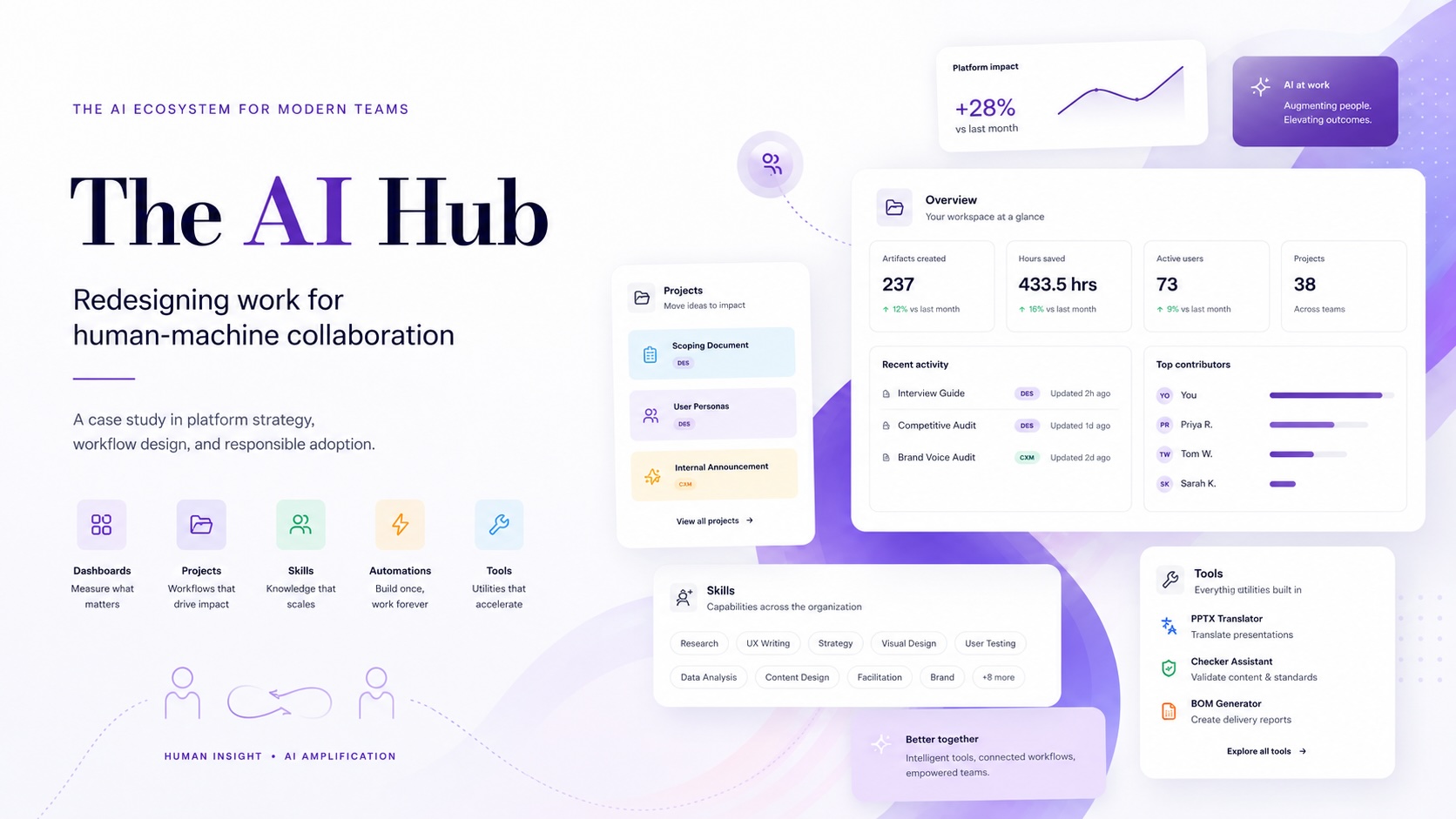
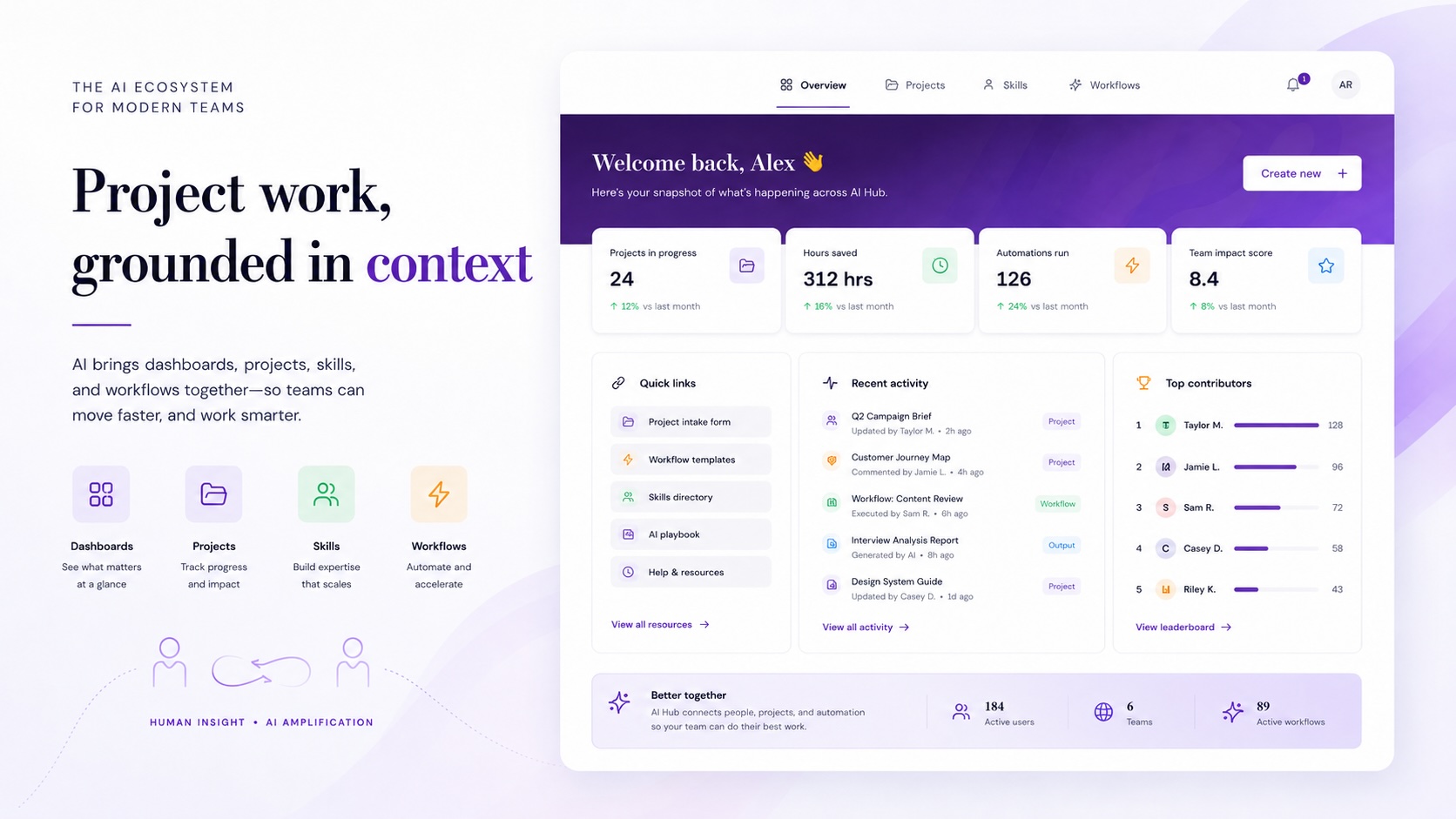
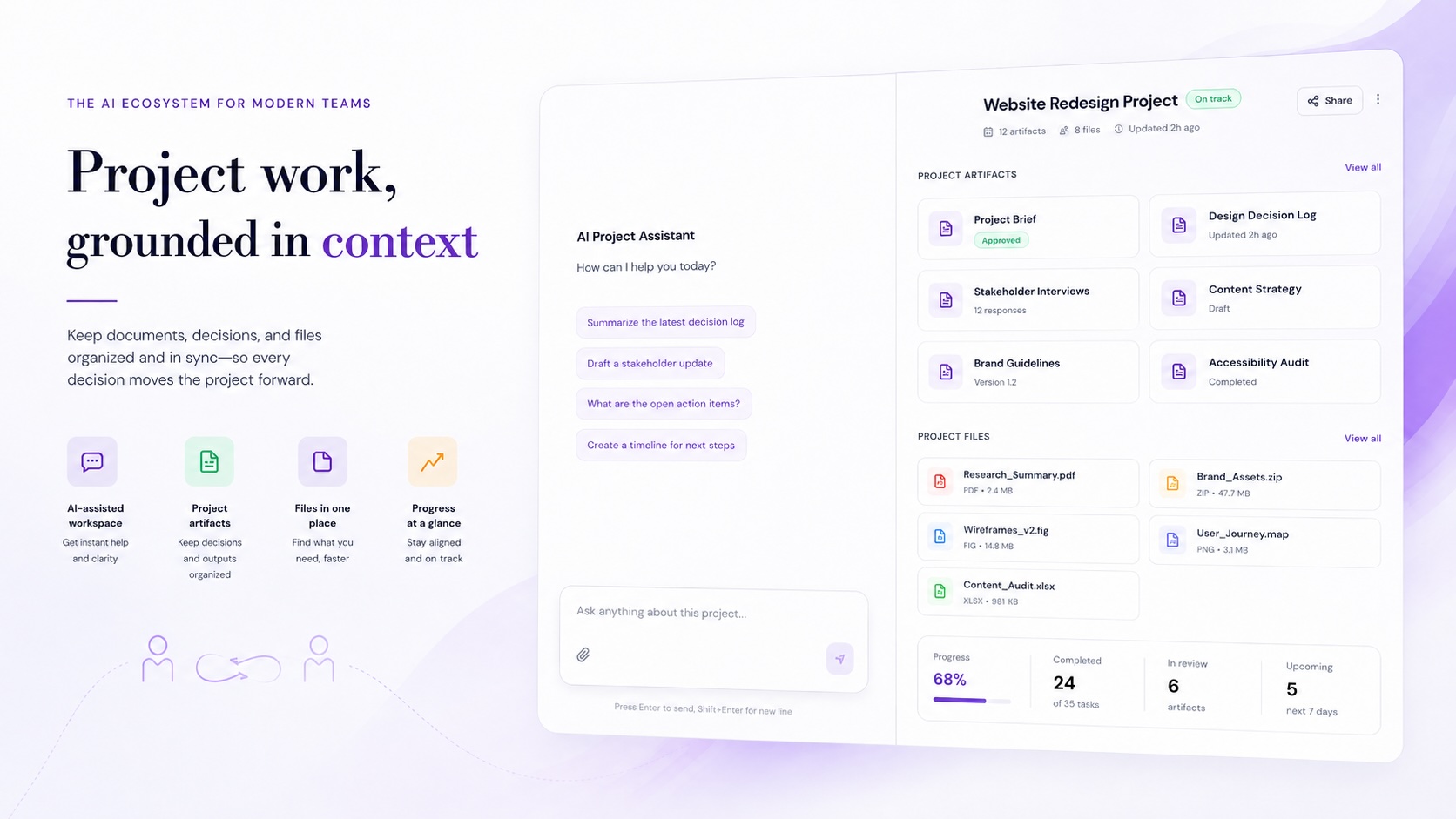
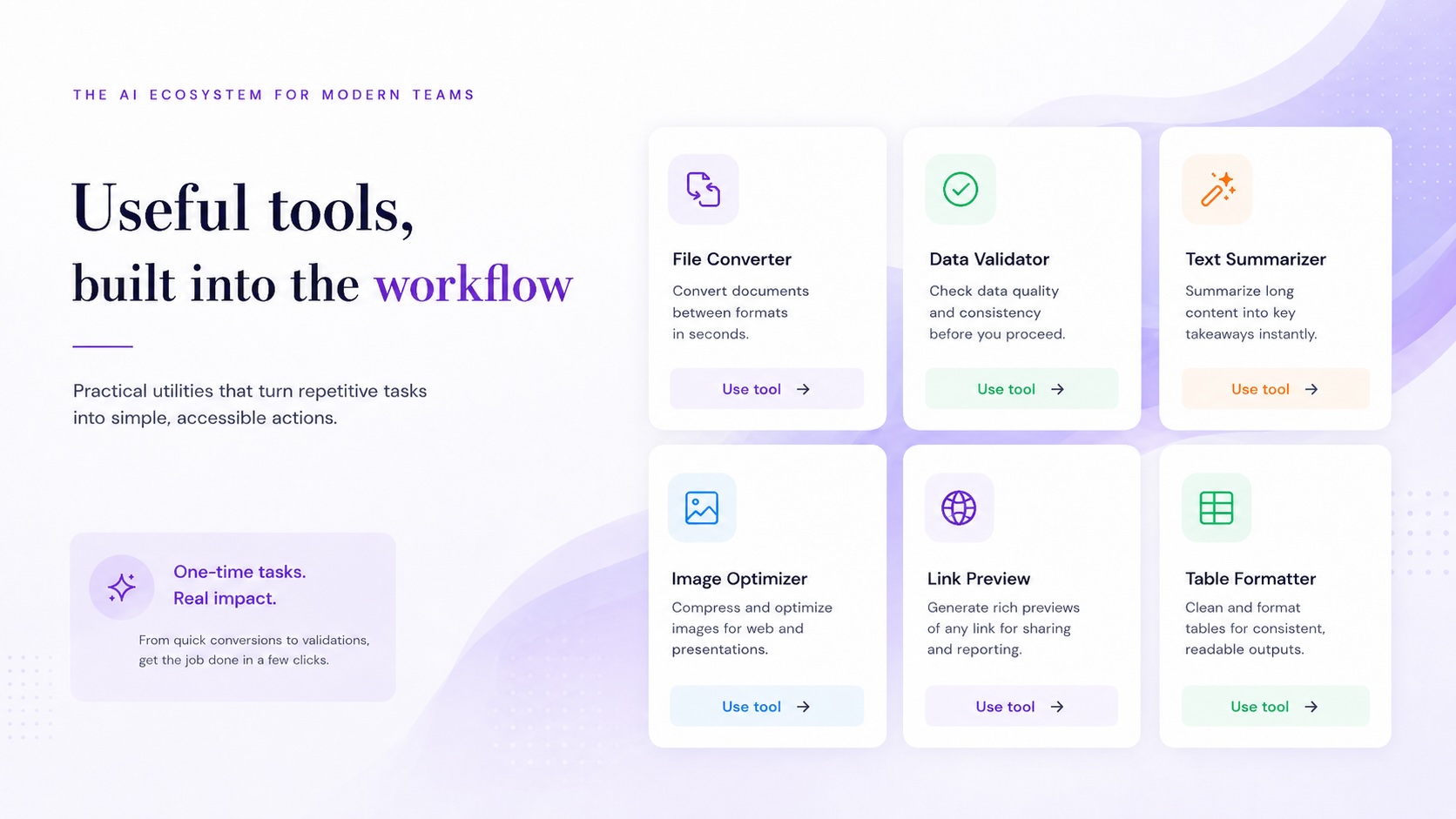
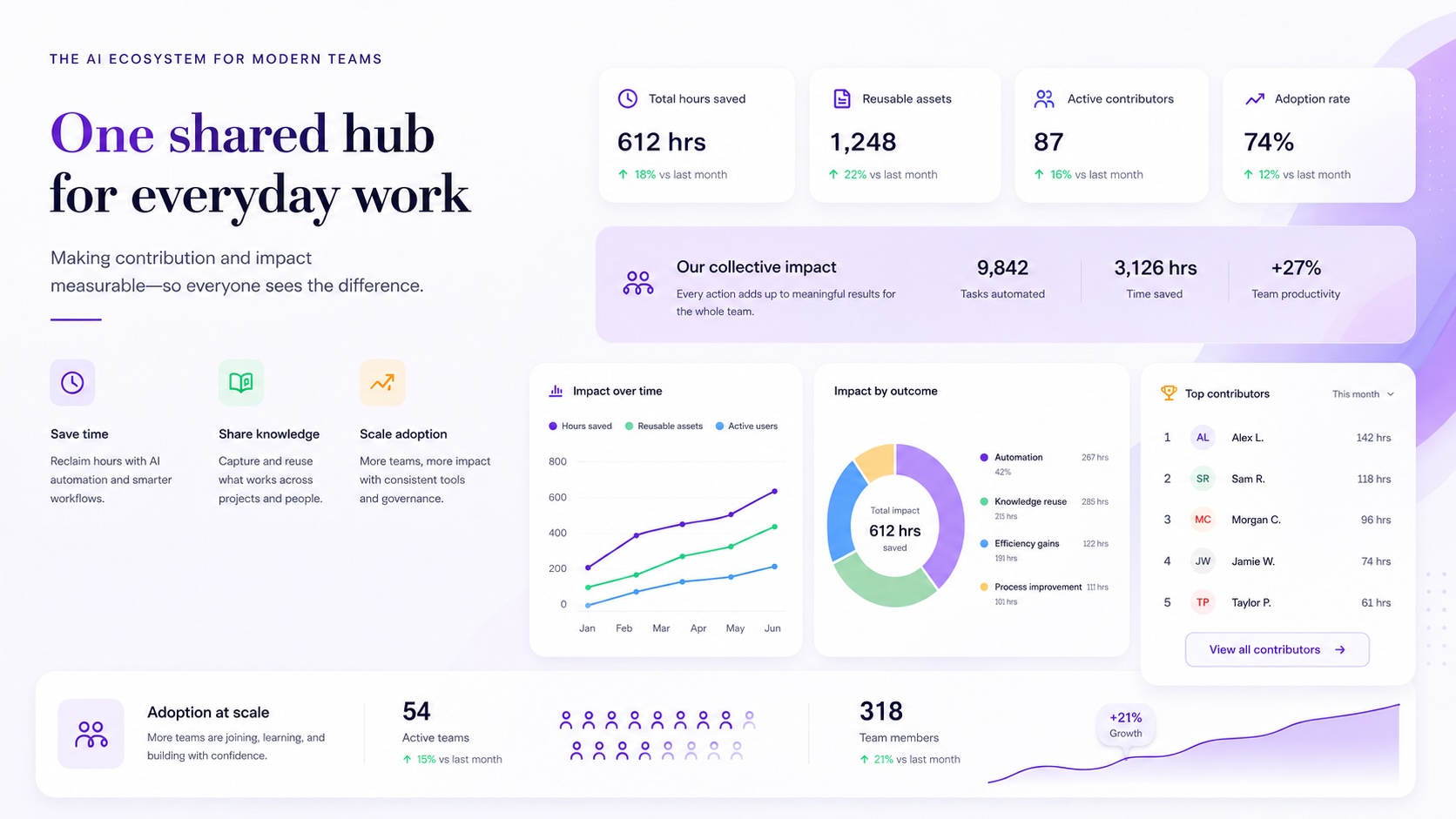
The centrepiece of the work is the DES AI Hub, a shared environment through which AI-assisted work can be explored, designed, governed, improved and reused across the organisation.
The distinction between a catalogue and a shared environment matters more than it sounds. A catalogue tells people what exists but a shared environment changes how an organisation learns.
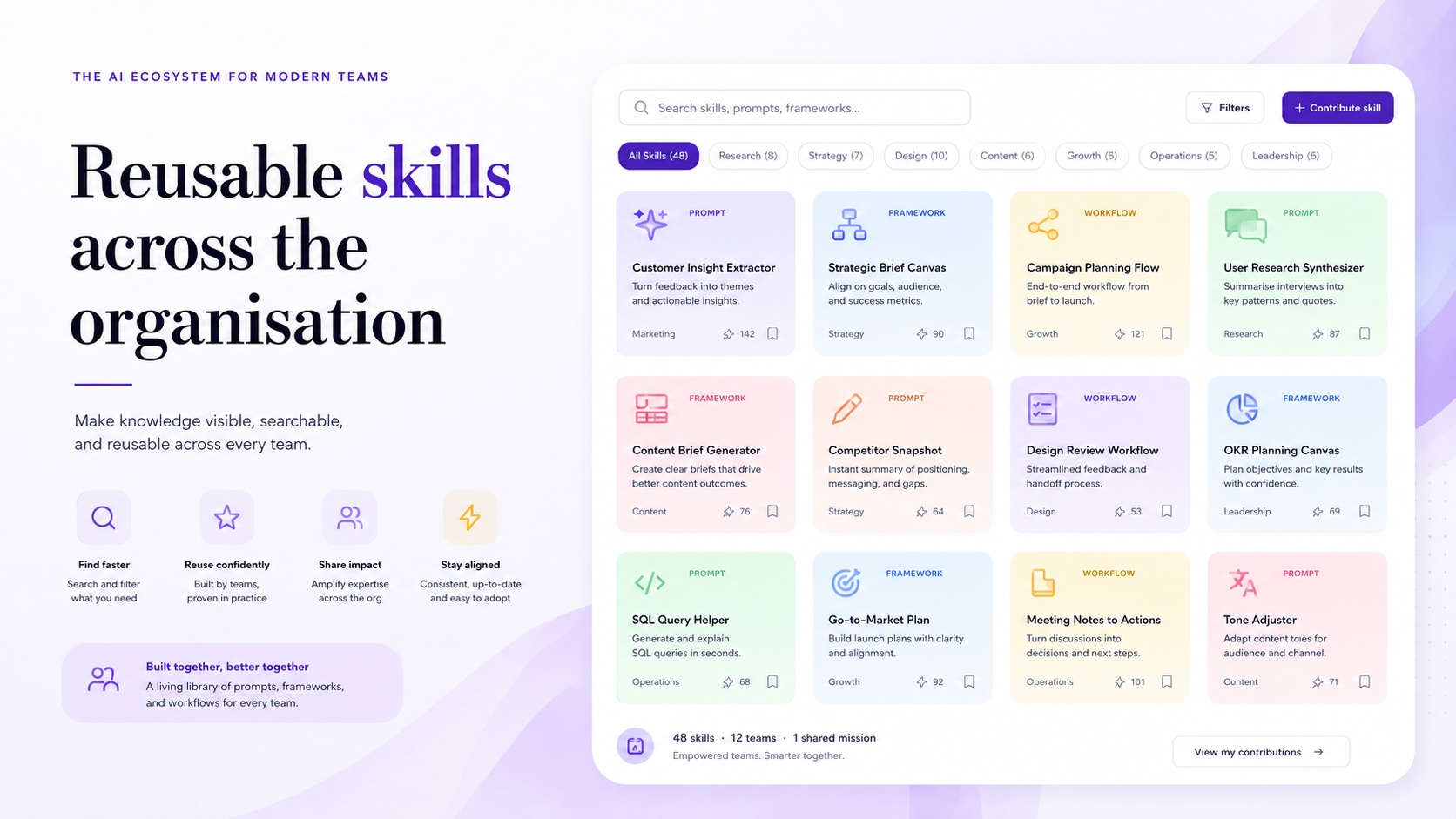
The Hub brings together AI projects and use cases, reusable automations, agents and assistants, shared skills, organisational rules, approved knowledge, governance and ownership, and evidence of use and value. Without this connective tissue, the proliferation problem doesn’t resolve, it compounds. One person builds an assistant, another team builds an agent, a third develops the same capability independently, and the organisation still cannot see what exists, understand what has been learned, or determine whether anything is safe to reuse.
With it, AI becomes visible, shared and governable. Agents can use approved capabilities. Skills can be version-controlled. Knowledge can be retrieved consistently. Previous experiments feed into new work rather than being abandoned when the person who built them moves on.
The platform becomes part of the organisational memory, not just a place where AI tools live, but a system through which people and machines work together more deliberately, and through which the organisation develops a genuine capacity to adapt to whatever comes next.
Redesigning work, not just automating it
A significant part of the strategy is a framework for understanding roles as evolving collections of jobs, workflows and tasks, rather than fixed job descriptions that either survive automation or don’t.
Most workforce planning treats a role as a stable unit. The framework I developed decomposes each role into the jobs a person is expected to accomplish, the workflows through which those jobs are completed, the tasks within each workflow, and the knowledge, systems and decisions each task requires. Each task can then be examined deliberately, should it remain human? Could AI assist? Could it be augmented or automated safely? Does it need to exist at all?
That last question is the one most automation programmes skip. They automate the existing process without first asking whether the existing process should continue to exist. The result is faster execution of work that was already poorly designed.
The framework also makes it possible to think seriously about what the remaining human role becomes as AI assumes or supports particular tasks. Not smaller, different. Tasks involving judgement, orchestration, evaluation, creativity, relationship-building and accountability come forward. Tasks that were previously divided across traditional role boundaries begin to recombine into new configurations. The boundaries between design, analysis, product, content and service disciplines become more fluid, which creates both opportunity and genuine uncertainty for the people living inside them.
The purpose of the framework is not to predict a final workforce structure. It is to create a system through which roles can evolve incrementally, reducing risk while generating learning continuously.
The human layer
The strategy rests on a principle that is simple to state and genuinely difficult to hold in practice: AI should strengthen human capability, not remove human responsibility.
This means automated workflows must be co-created with the people who use them or are affected by them. It means efficiency must be balanced with transparency, people need to understand what the system is doing on their behalf and why. It means humans must remain meaningfully involved wherever judgement, risk, ethics or accountability are at stake. It also means automation should restore cognitive and creative capacity by removing avoidable friction, not simply increase the volume of work expected from the same number of people.
That last distinction is where most AI transformation arguments break down in practice. The business case is usually framed around efficiency. The human experience of it is usually anxiety about replacement. The only way through that tension is genuine co-design, people shaping the system that will affect their work, rather than receiving it as a finished product from a strategy team and a vendor.
Alongside the technical architecture, I built a participatory adoption model. An AI and Automation Community of Practice, focused circles within disciplines, guild ambassadors, coaching clinics, a prioritised automation backlog, cross-disciplinary experimentation, shared documentation of patterns and lessons. The goal was adoption through participation rather than instruction, people who contribute use cases, test ideas, learn from peers and help shape the system, rather than simply being trained to use it.
What the build has confirmed
The technology is the tractable part. The human layer takes longer, as it always does.
The hardest conversations have not been about architecture or tooling, they have been about identity. What does it mean to be a designer when AI can generate a hundred options in the time it once took to sketch three? What does a senior researcher do when the synthesis work that used to take a week takes an afternoon? These are not edge cases or future concerns. They are present tense, and they are the questions that determine whether transformation actually works.
An organisation can implement AI successfully by technical measures and still lose something essential in the process, the confidence of its people, the quality of its judgement, the sense that work is still theirs to own. Getting the human layer right is not a soft consideration alongside the real work. It is the real work.
This is what I mean when I talk about designing from the edge inward. The people closest to the friction, the ones whose workflows are changing, whose roles are shifting, whose expertise is being reconfigured by tools they didn’t ask for, understand the system better than any strategy document does. Starting there, and working back toward the architecture, produces better outcomes than any other sequence I have found.
Responsible AI and the EU AI Act
Running alongside the platform and workforce work was a third strand that I considered equally foundational, responsible AI design.
Most organisations treat compliance as something that arrives after the system is built, a review process, a legal sign-off, a checklist appended to a deployment plan. I treated it as upstream architecture. The questions the EU AI Act forces organisations to ask, which systems carry risk, who is accountable for automated decisions, where human oversight is non-negotiable, how transparency is maintained for people affected by AI-assisted processes, are not compliance questions. They are design questions and if you wait until the system is built to ask them, you are already in trouble.
I introduced responsible AI practice into the Design organisation as a working methodology, embedding ethical frameworks into tool evaluation, building human oversight into workflow design at the task level, and helping the team develop the judgement to ask not only can we automate this but should we, and under what conditions. The EU AI Act provided a useful external frame, its risk classification logic maps directly onto the kind of task-level analysis the workforce framework was already doing. High-risk decisions need human oversight by design, not as an afterthought. Transparency obligations need to be built into how agents communicate with the people they affect.
This is not a burden on top of the work. It is what responsible transformation looks like from the inside. Again, we can tie it all back to the protection of life, intellect, society, posterity, ecology and wealth. People, planet and prosperity or some version of those.
Why this matters beyond this engagement
The Proximus work brought together everything I had developed across the preceding decade, futures research, human-centred design, venture architecture, responsible technology, workforce transformation, systems thinking, organisational change.
More than that, it confirmed something I have believed since I first encountered systems that were designed without the people inside them in mind.
I grew up in apartheid South Africa. Systems were never abstract to me. I understood early, and viscerally, that the rules embedded in a system determine whose voices are amplified and whose are silenced, and that most people subject to those rules had no part in designing them. That understanding has never left. It shows up in every framework I build, every strategy I write, every room I walk into.
AI is the most consequential system design challenge of this era because the decisions being made right now about how it is built, governed, deployed and explained will determine, at scale, who retains agency and who quietly loses it. Who remains a participant in their own working life and who becomes a subject of a system they cannot read or influence.
The EU AI Act is an attempt by a jurisdiction to hold that line, to insist that certain decisions remain human, that certain systems remain explainable, that certain risks cannot simply be absorbed by the people with the least power to push back. I believe in the impulse behind it, even where the implementation will be imperfect. Compliance without understanding is just paperwork. Understanding is what I try to build.
This is what connects the smart assistant to the value based venture framework to the African Futures Academy to the MultiChoice accelerator to the work I do inside Proximus today. In every case, the question underneath the visible work has been the same, who is this system actually for, who designed it, and does it distribute power and agency more fairly than the one it replaced?
That is not a political question, it is a design question and it is the question I bring into every advisory engagement, every strategy conversation, every room where consequential decisions about AI and the future of work are being made.
The technology is rarely the real problem, the question underneath it almost always is.
Copyright @ Zahara Chetty PTY LTD 2026