Case Study: A values-informed framework for futures and venture design

What Is an Economy Actually For?
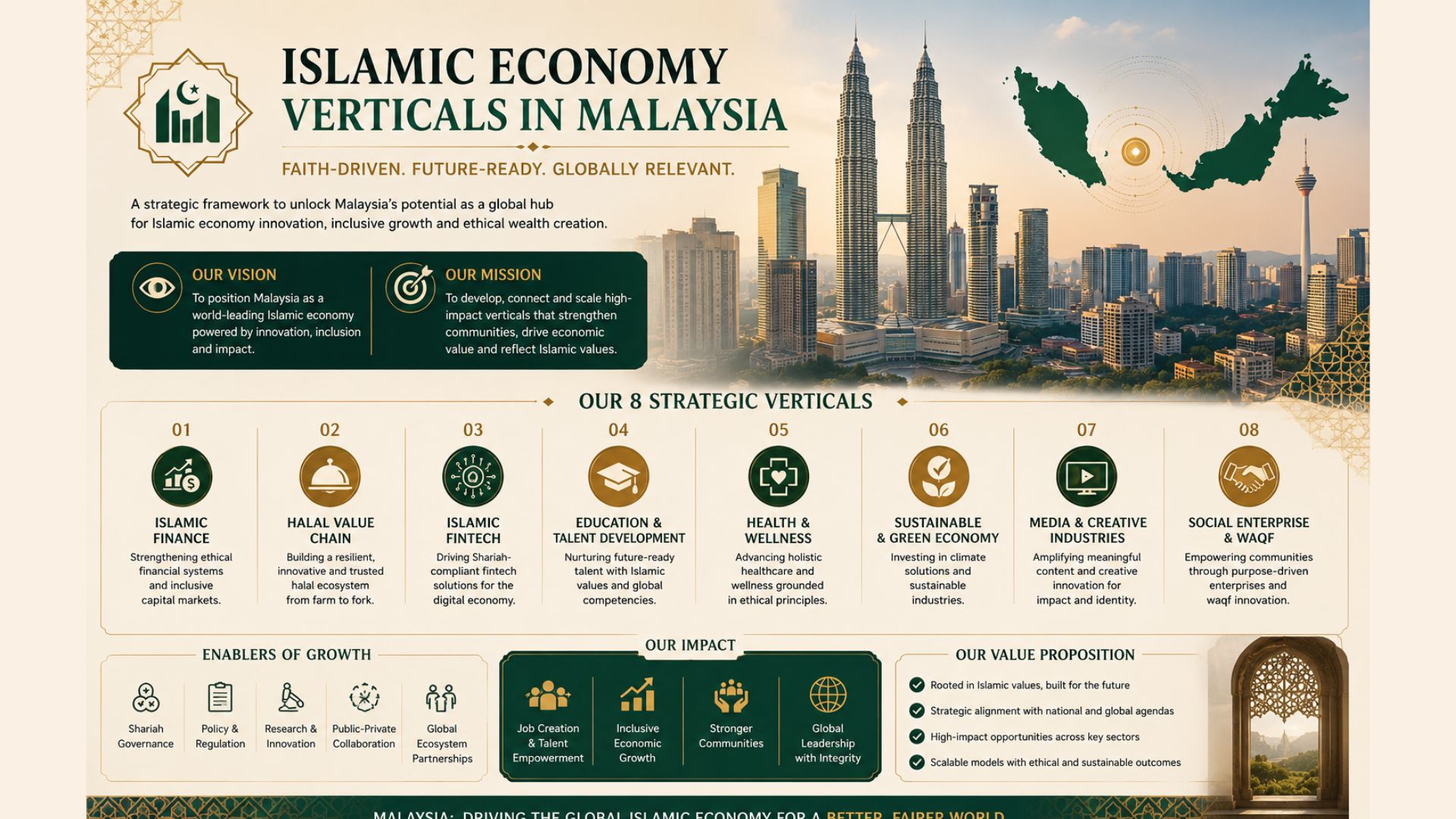
Most frameworks for economic opportunity start with what is already being sold.
They begin with existing market categories, halal food, Islamic finance, modest fashion, travel, media, and ask how to grow them. That is a useful commercial exercise. It is also a fundamentally conservative one. It reproduces the shape of what exists rather than asking whether what exists is actually serving the people it claims to.
In 2020, working with Andalus Ventures, I started from a different question, “What is an economy ultimately intended to protect, develop and make possible?”
That question led me to the Maqasid al-Shariah, the higher purposes that provide ethical orientation in Islamic thought, and to the realisation that they offered something the Islamic economy conversation was almost entirely missing, a framework for evaluating economic activity not by what it produces, but by what it protects.
The design problem
The global Islamic economy is significant in scale. It is also, in much of its mainstream representation, a market segmentation exercise. Products and services are evaluated primarily for compliance, does this meet the standard?, rather than contribution, does this make things genuinely better for the people it reaches?
Compliance is necessary, but it is not sufficient.
A financial product can be structured to avoid prohibited elements and still extract value from communities with limited alternatives. A food business can meet certification requirements and still depend on labour practices that violate the dignity of the workers producing it. The letter of the framework can be satisfied while its spirit is systematically undermined.
I wanted to design something that moved ethical thinking upstream, that asked the right questions before a business model was defined, not after it was already built.
The framework I built
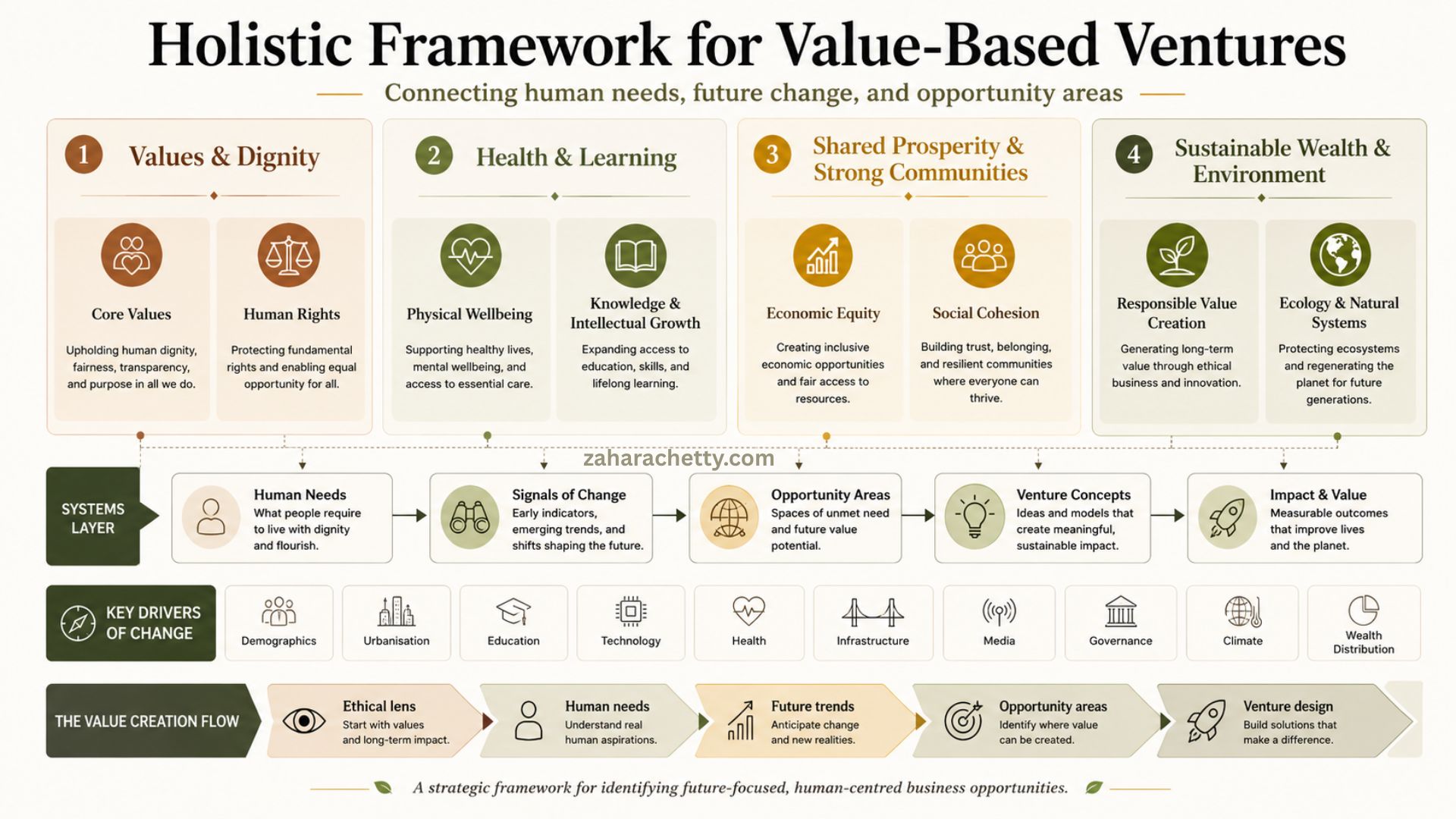
The values based framework I developed maps the higher purposes, the protection of life, intellect, society, posterity, ecology and wealth, onto the actual needs people experience across their lives.
- Protection of life encompasses dignity, safety, health and the conditions required to live securely.
- Protection of intellect covers education, knowledge, discernment and the ability to make informed decisions, including, critically, examining what technology and commercial systems do to human attention and judgement.
- Protection of society includes belonging, trustworthy institutions and the relationships through which communities sustain themselves.
- Protection of posterity considers the long-term consequences of present decisions on families, children and cultural continuity.
- Protection of ecology recognises that prosperity depends on the responsible stewardship of finite natural systems.
- Protection of wealth means dignified work, legitimate enterprise, financial resilience and fair access to economic opportunity.
These purposes are not independent. A venture can create financial wealth while weakening families, exploiting workers, manipulating behaviour or damaging the environment. The framework therefore asks whether value is being created across the system, or merely extracted from one part of it.
The second layer examined the forces most likely to reshape the needs of Muslim communities over the coming decades. Demographic change, urbanisation, ageing, migration, AI, the future of work, climate change and the unequal distribution of wealth, not to predict a single future, but to understand how different combinations of change create new vulnerabilities, new aspirations and new areas where something genuinely useful could be built.
The third layer translated those ethical principles into questions that founders and innovation teams could actually use: What do people need at different stages of life? Where are people unable to access knowledge, services, work or capital? Which forms of value are currently invisible or poorly rewarded? What should remain unchanged, and what must be redesigned?
What it was designed to do
The framework was generative, not prescriptive. It didn’t dictate which businesses must be created, but it helped teams discover opportunities by examining the relationship between values, human needs, future change and gaps in existing systems.
It also looked beyond the product to the whole value chain.
- How is it made?
- Who performs the work?
- Who owns the venture and its data?
- Where does the capital come from?
- Who carries the risk?
- What happens when it scales?
- What behaviours does the business model reward?
This turned Maqasid from a statement of aspiration into a practical design and governance discipline. A value-based business, in this model, is not a charitable project with religious branding. It is a commercially viable organisation whose purpose, operations and measures of success are aligned with the protection and development of human, social and ecological wellbeing. Profit matters, a venture must be capable of sustaining its work. But profit is one form of value, not the only evidence of it.
The central question was not can this business operate within an Islamic market? It was, “What kind of economy and society will exist if this business succeeds?”
What building this framework taught me
This was the project that made explicit something I had been circling since QuranJourney, that the most important design decisions in any venture are not product decisions, they are system decisions.
Who the venture is accountable to. How it treats the people inside it. What it does with the value it generates. Whether it strengthens or weakens the relationships and communities it depends on. These are not values questions bolted onto a business after the model is set. They are architectural. They determine what the venture actually is.
The Maqasid framework also confirmed something about the nature of futures work that I now carry into every engagement. The future is not a prediction problem. It is a values problem. What we build next depends entirely on what we decide matters, and most organisations make that decision implicitly, by default, when they choose a business model and a set of incentives and stop asking questions.
Making that decision consciously, deliberately, before the architecture is fixed and that is the important bit. In the Islamic economy context, in enterprise AI transformation, in African founder ecosystems, the question is always the same. “What are we actually trying to protect, and does the system we are building actually protect it?”
Why this matters for the work I do now
The Maqasid framework was, in practice, an early version of what I now bring to every advisory engagement, a structured way of asking what a system is actually for, before optimising it.
When I work with organisations on AI transformation, I am not only asking which workflows to automate. I am asking what the organisation is trying to protect, human judgement, dignity, the capacity of people to remain self-determining inside systems that are increasingly designed to shape them. When I work with founders, I am not only asking whether the business model is viable. I am asking what kind of relationships and conditions it will create when it scales.
Ethics is not a layer added at the end. It is upstream architecture. The Maqasid work gave me a rigorous way to hold that position, and the evidence that it produces better ventures, not just more virtuous ones.
Copyright @ Zahara Chetty PTY LTD 2026