Case Study: The African Futures Academy



From futures literacy to a founder-support system for Africa’s new economy
Most conversations about Africa’s future are held without Africans in the room, or held about them, rather than with them. Technology will arrive and disrupt, markets will open or close, global institutions will fund certain kinds of progress and not others. The continent’s young people are frequently positioned as recipients of futures designed elsewhere, not as authors of futures they might choose to build themselves.
In 2020, I founded the African Futures Academy to push against that framing.
The question at the centre of the work was simple and consequential: how do you help young Africans become active authors of the future, rather than passive inheritors of it?
The gap I was designing for
The conventional answer to youth development is skills. Teach coding, teach financial literacy, teach entrepreneurship. These matter, but they rest on a foundation that is rarely addressed, the capacity to question assumptions, imagine alternatives, understand systems, and locate yourself as someone with agency inside forces that are actively shaping your life.
Without that foundation, skills become tools for navigating a system you don’t understand and didn’t design, but with it, they become instruments for changing one.
I had spent four years researching futures of work, megatrends, African socio-political context and the gap between what education systems were producing and what an uncertain economy was going to require. The research kept pointing at the same place: the missing capability wasn’t technical. It was systemic. Young people needed to understand the forces shaping their world well enough to act on them deliberately.
That became the African Futures Academy.
What I built
The Academy brought together futures literacy, identity, systems thinking and ethical technology under one framework, the 21 FutureSkills for 21st Century Citizens, grounded in partnerships with the Institute for the Future, the World Economic Forum, Aflatoun International and Ashoka.
The curriculum was structured across three contexts of Self, Society and Systems. The premise was that you cannot meaningfully shape the future if you experience yourself only as a subject of systems you cannot influence. Personal clarity and systemic awareness had to develop together.
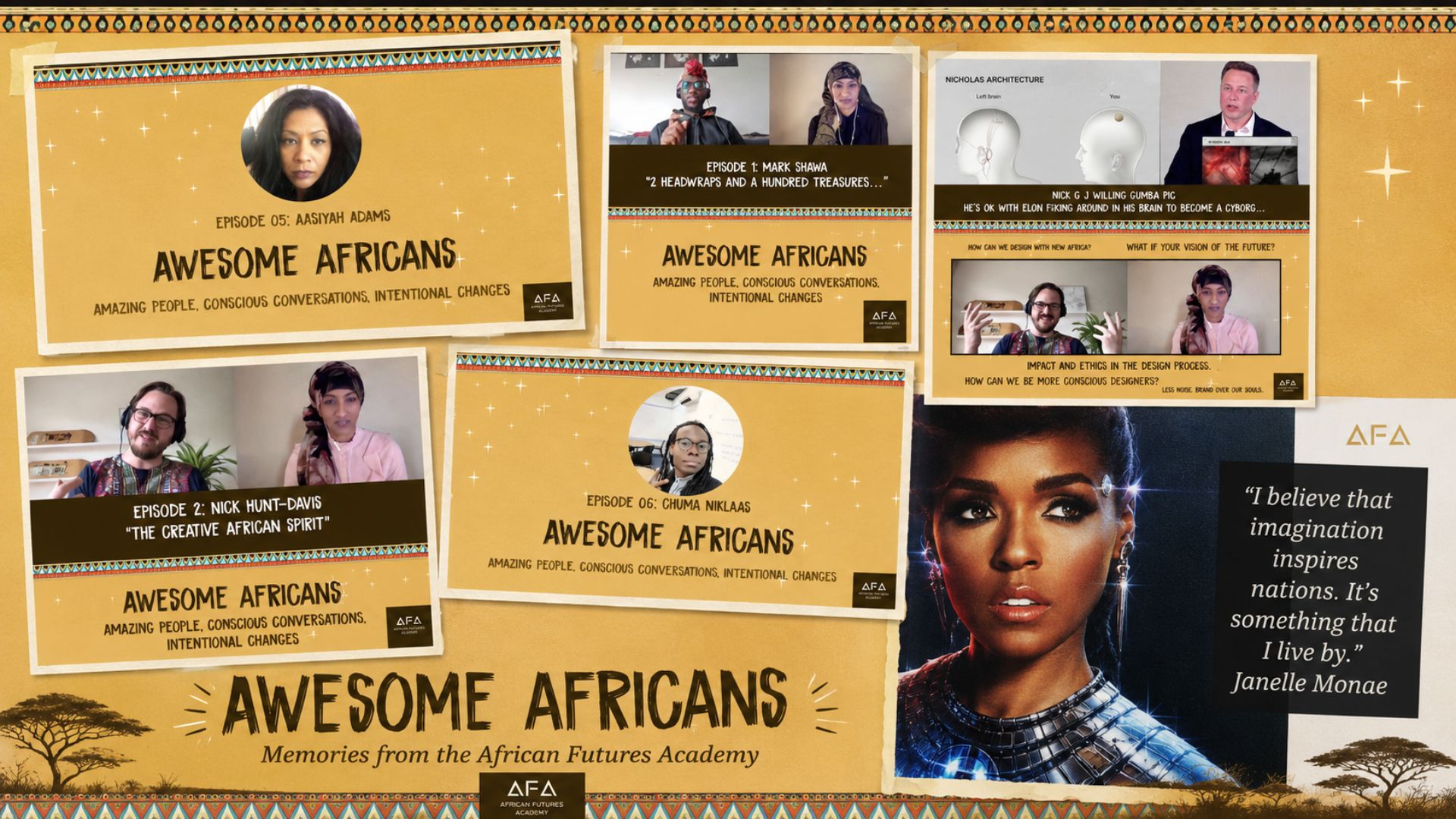
Through the Awesome Africans interview series, I spoke with African thinkers, technologists, entrepreneurs and changemakers, making alternative forms of leadership and possibility more visible, and demonstrating that African knowledge and experience were legitimate starting points for futures thinking, not just local context to be noted before the global frameworks arrived.
The Academy also connected participants to international futures, speculative design and youth foresight communities. African questions, placed in conversation with a global field of practice.
What the work revealed
The first iteration confirmed something I had suspected but needed to test, futures literacy works. People became more able to question inherited assumptions, imagine alternatives, and locate themselves as agents inside complex systems.
It also revealed the limit of stopping there.
A person can develop genuine futures literacy, real capacity to imagine differently, and still lack the infrastructure to build anything. The gap between imagination and action isn’t a motivation problem. It’s a structural one. Early-stage founders in Africa face missing pathways at almost every stage: testing ideas with real communities, finding collaborators, accessing capital, navigating regulatory systems, sustaining themselves financially and psychologically while building.
Futures literacy opens the imagination. Founder infrastructure helps people act on it. The Academy needed both, and had only built the first.
That insight shaped everything I did next, and continues to shape how I think about systems change. Changing what people can imagine is necessary but not sufficient. The system around the imagination has to change too.
Why this matters for the work I do now
The African Futures Academy was an early, practical expression of the question that runs through all my work, “Who has the standing and the support to participate in designing what comes next?”
It also reinforced a pattern I keep encountering across very different contexts, from a four-person R&D team building a conversational AI in 2018, to an enterprise AI rollout inside a European telco in 2025. You can build something that works. You can build something people believe in. And it can still fail to endure if the system around it hasn’t been designed with equal care.
The technology, the product, the curriculum, these are never the whole problem. The infrastructure, the governance, the operating model, the cultural conditions, these are where things hold or fall apart.
Understanding that difference is what a systems futurist actually does. Not predict what’s coming. Design the conditions that make something worth building, survivable.
Copyright @ Zahara Chetty PTY LTD 2026