Case Study: Redesigning work for human-machine collaboration, before building AI
Work was chaotic when AI came into the picture
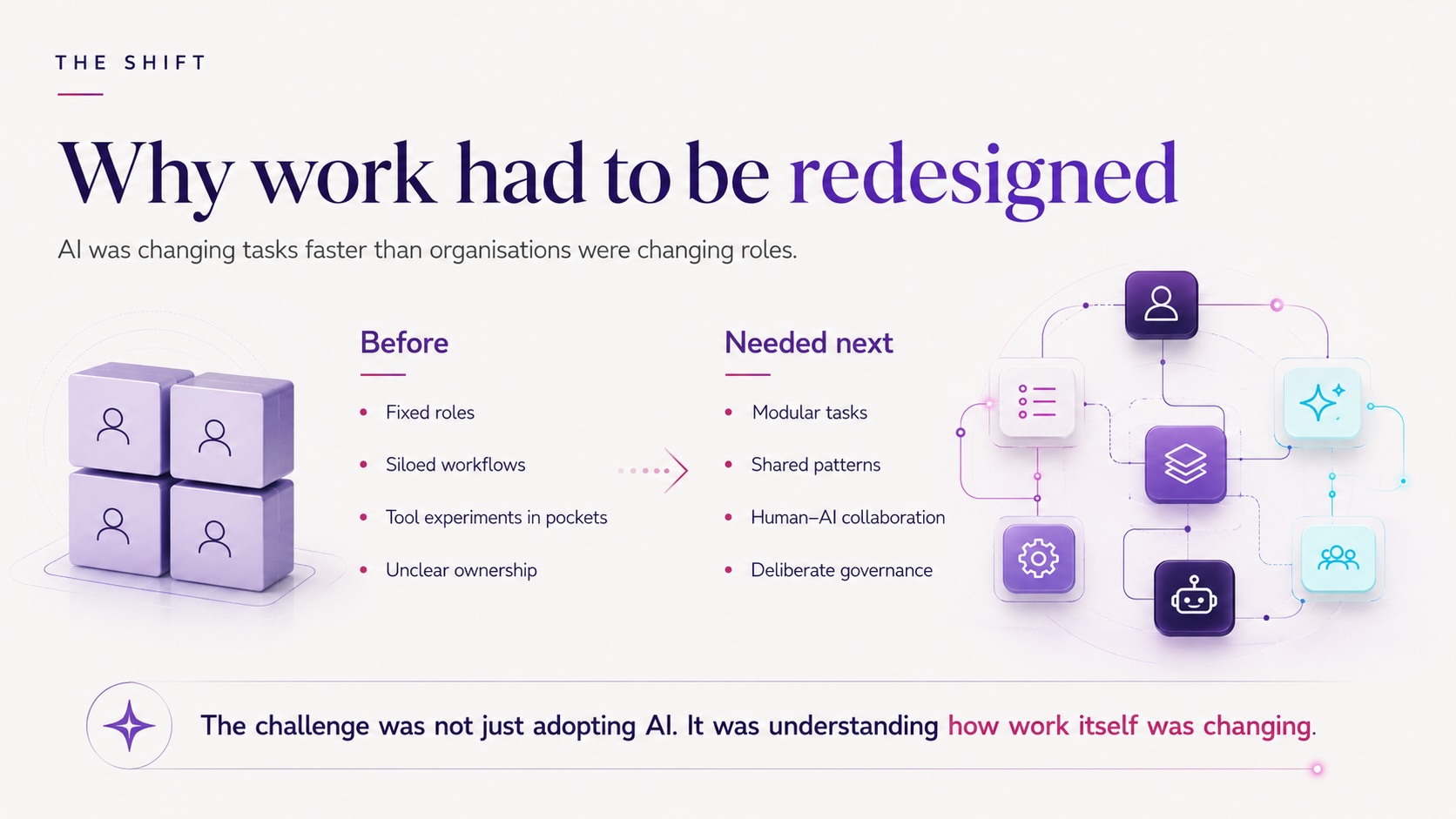
People were experimenting with generative AI. Teams were developing proofs of concept. Leaders were looking for efficiency gains and, at the same time, employees were experiencing growing uncertainty about their roles, their skills and what increasingly capable systems might mean for their futures. The organisation did not need an AI adoption plan. It needed a way to understand how work itself was changing, and what that meant for the people doing it.
I developed a future-of-work strategy and practical redesign framework that allowed the organisation to examine work at the level where change was actually happening. Not through job titles or broad forecasts, but at the level of roles, jobs, tasks and workflows, where the real decisions about human and machine contribution would ultimately be made.
The problem with conventional workforce planning
Most workforce structures were designed for a world in which people performed work inside relatively stable roles. AI disrupted that logic without replacing it with anything better.
A role that appeared unchanged on an organisational chart could already be shifting significantly in practice. Some tasks were being automated. Others were accelerating with AI assistance. New forms of review, orchestration and accountability were emerging. At the same time, employees were experiencing cognitive overload from continuous experimentation, similar use cases being explored independently across teams and genuine anxiety about losing expertise, relevance or employment.
Traditional workforce planning could not respond to this. Job titles were too broad. Skills lists became outdated quickly. Technology-first approaches automated isolated tasks without considering the effect on the wider workflow.
The insight that reframed everything
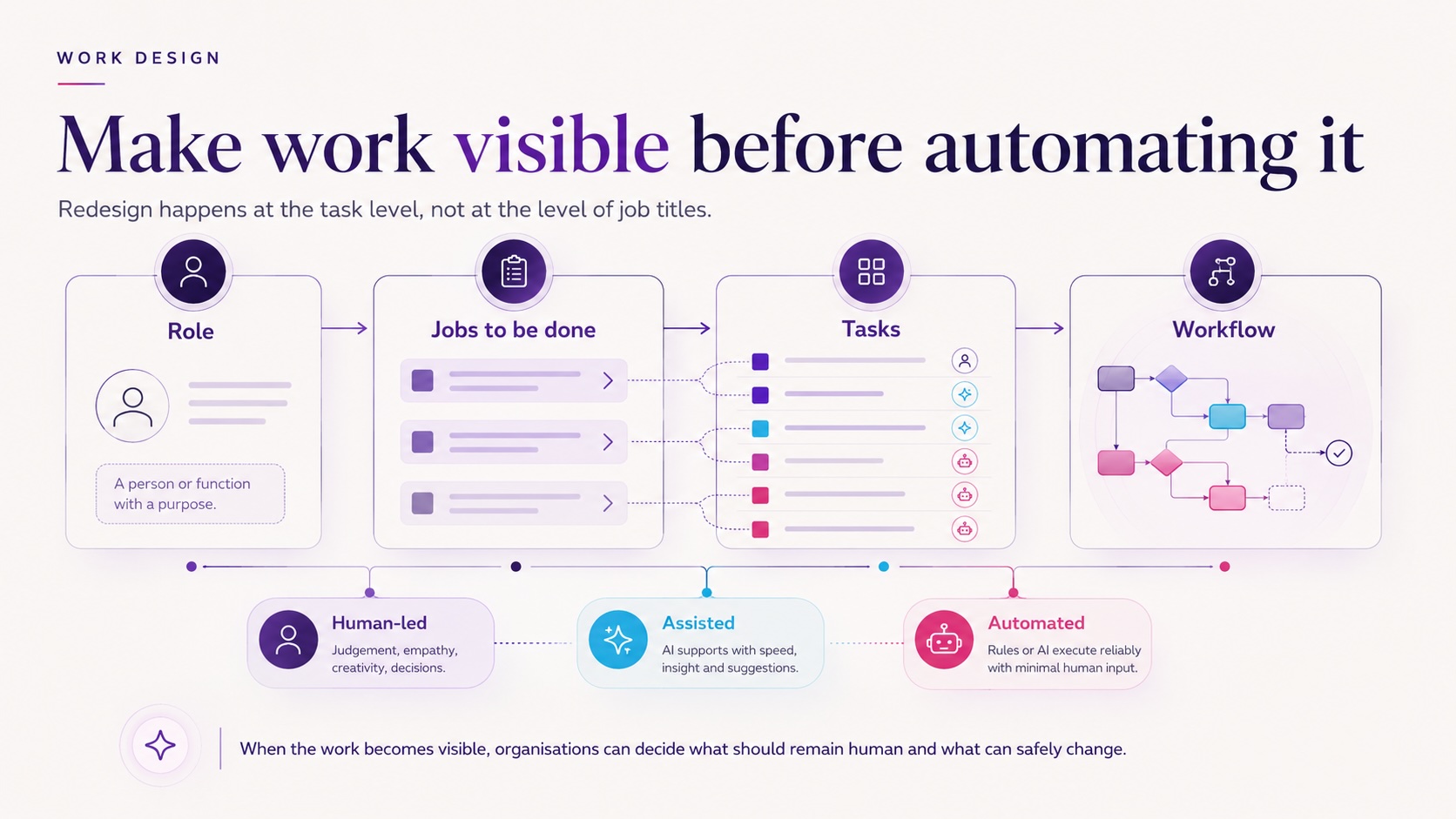
A role is not a single unit of work. It is a collection of jobs a person is expected to complete. Each job contains a sequence of tasks. Each task receives an input, applies a process and produces an output. Some tasks require interpretation, relationships, ethical judgement or contextual knowledge. Others follow stable patterns that can be supported or performed by a machine.
Once this structure becomes visible, workforce transformation becomes more precise. The organisation no longer has to speculate about whether an entire role will be automated. It can examine how individual parts of the work may change, what new responsibilities emerge and where human judgement must remain protected.
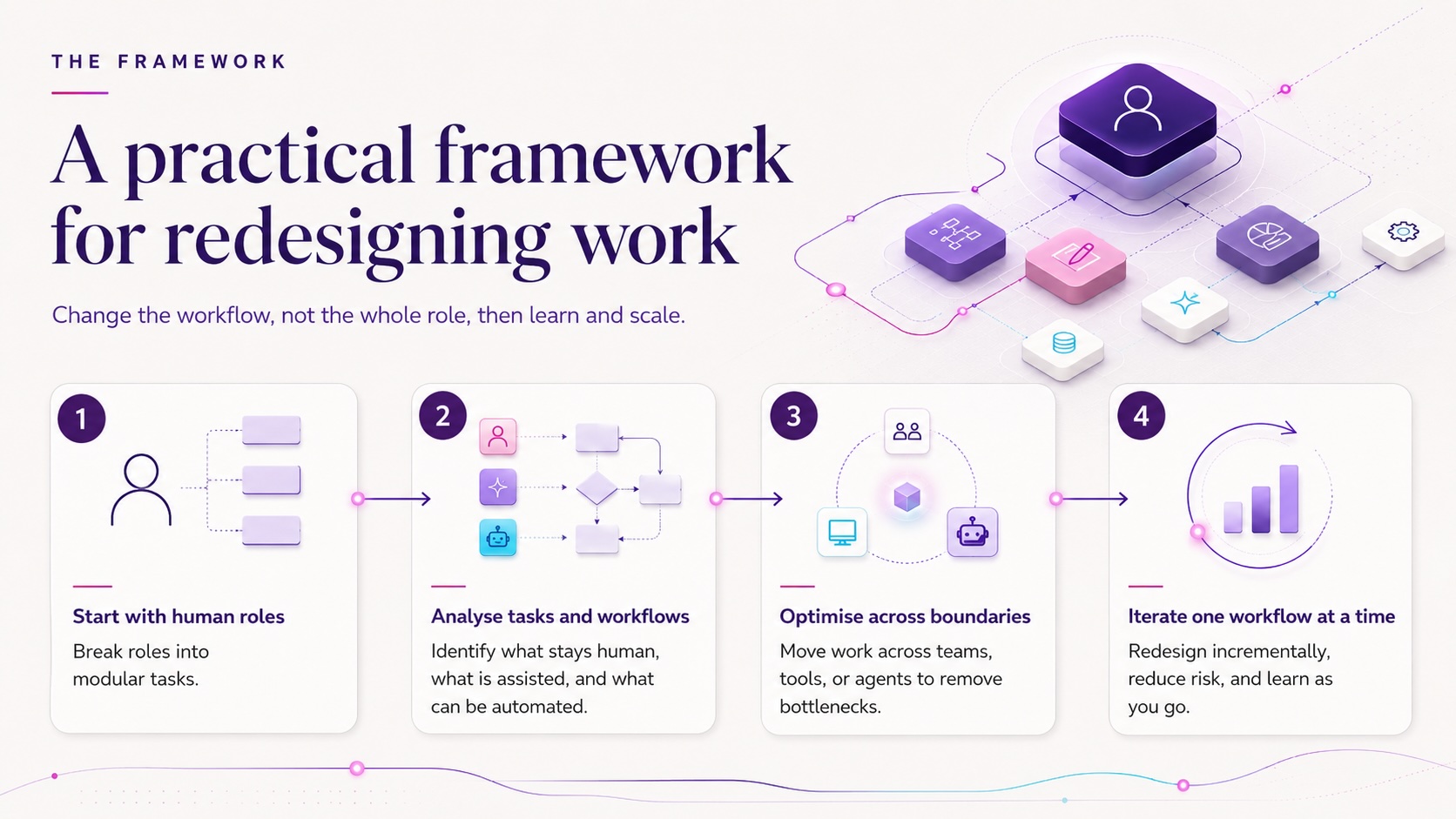
This became the foundation of a fungible future-of-work model, one where roles could evolve without being treated as fixed containers, work could move between people and intelligent systems, and change could happen one workflow at a time.
Participatory future-of-work sessions
Workforce redesign cannot be done through spreadsheets alone. I facilitated future-of-work reimagination sessions that combined strategic foresight, role exploration and practical workflow design. Participants considered how their work might evolve, what they wanted technology to remove, what they wanted it to strengthen and which aspects of their professional contribution they believed should remain distinctly human.
These conversations surfaced more than use cases. They revealed fears about professional identity, concerns about losing craft knowledge and opportunities for collaboration that existing role boundaries had obscured. People were no longer being asked to adopt a future designed elsewhere. They were being invited to participate in designing how their own work would evolve. That distinction between adoption and authorship is one I have come to see as decisive in every transformation I work on.
What the framework produced
The project produced a connected set of assets. A future-of-work strategy for human and machine collaboration, a modular framework connecting roles, jobs, tasks and workflows, a spectrum for determining appropriate levels of automation, a readiness method, a low-risk experimentation process and inputs for agentic workflow and platform design.
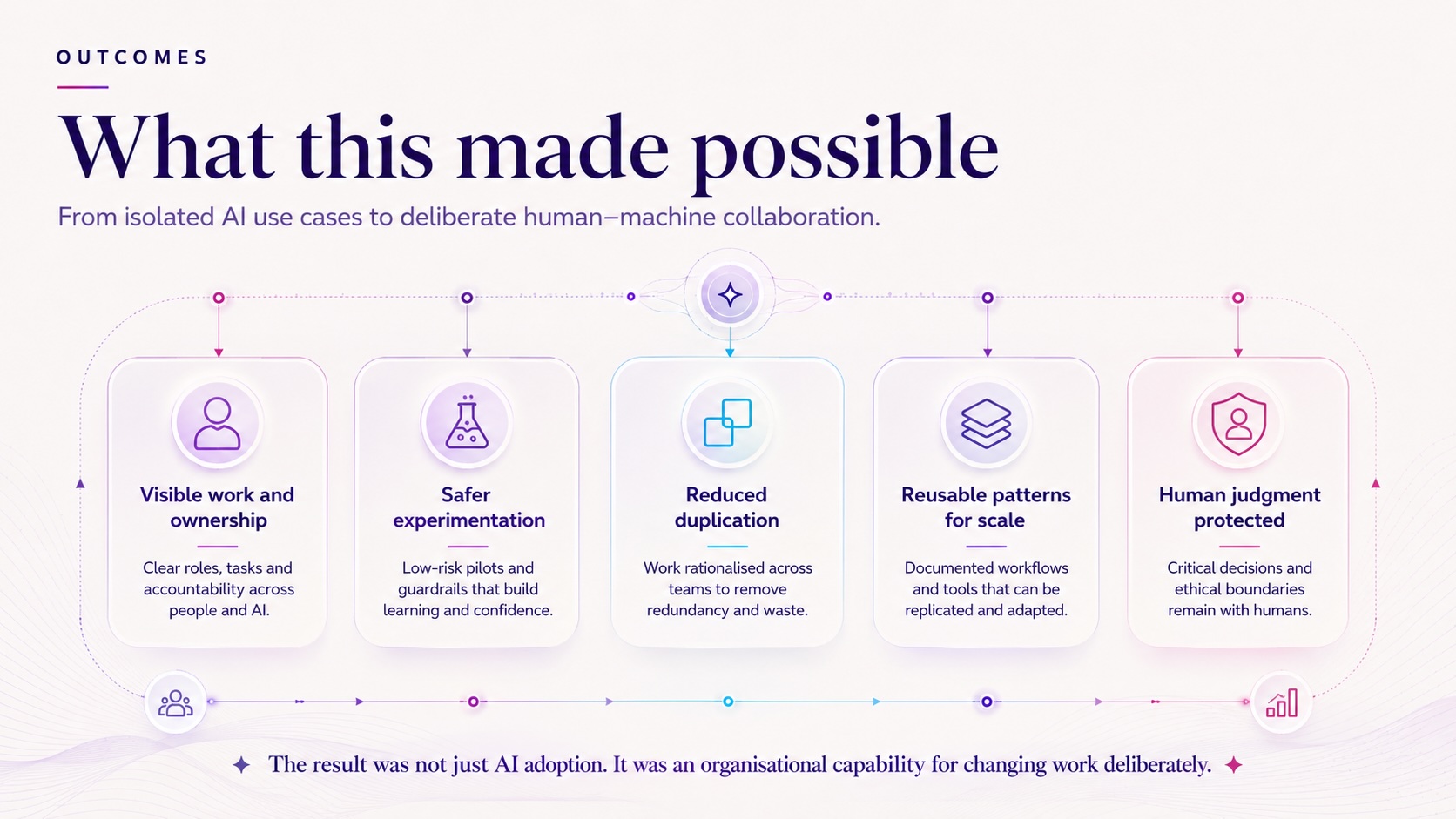
The most important outcome was not a forecast of how many jobs AI might change. It was an organisational capability for changing work deliberately, and a clear understanding of what that required from the people inside it.
What this changed in my thinking
The future of work is often presented as a question about technology. In practice it is a question about organisational imagination. The deeper opportunity is to redesign work so that people can contribute more of what requires judgement, creativity and responsibility, while machines take on work that is repetitive or unnecessarily burdensome. That possibility does not emerge through automation alone. It requires making work visible, distributing authority carefully and letting the people closest to the work participate in redesigning it.
The most dangerous outcome of AI adoption is not replacement. It is the removal of the very knowledge required to supervise the systems that get introduced. Efficiency without retained human capability creates dependency, not transformation.
The technology changes quickly. The strategic task remains the same: decide what kind of work we are creating, what kind of people our systems allow us to become and where responsibility must remain human.
From a good future to living systems
The Good Future Project taught me how to make alternative futures visible. Bloomforge Lab carries that learning forward by asking how those futures might become tangible.
The Good Future Project asked, what might a good future look like? Bloomforge asks, what should we build now to help that future take root? One helped change the narrative. The other is concerned with turning possibility into infrastructure.
Technology alone does not determine the future, neither do experts, institutions or markets. The future is shaped by the stories people inherit, the voices they hear and the communities through which they act. Future-building begins before the prototype. It begins with imagination, but imagination is only the beginning. The larger task is helping people move from seeing a different future to becoming capable of creating it.
Copyright @ Zahara Chetty PTY LTD 2026