Case Study: The Good Future Project, from Future barratives to Future-building
Building a global community around a more human story of the future
The future is not shaped only through technology, policy or investment. It is also shaped through the stories people believe are possible.
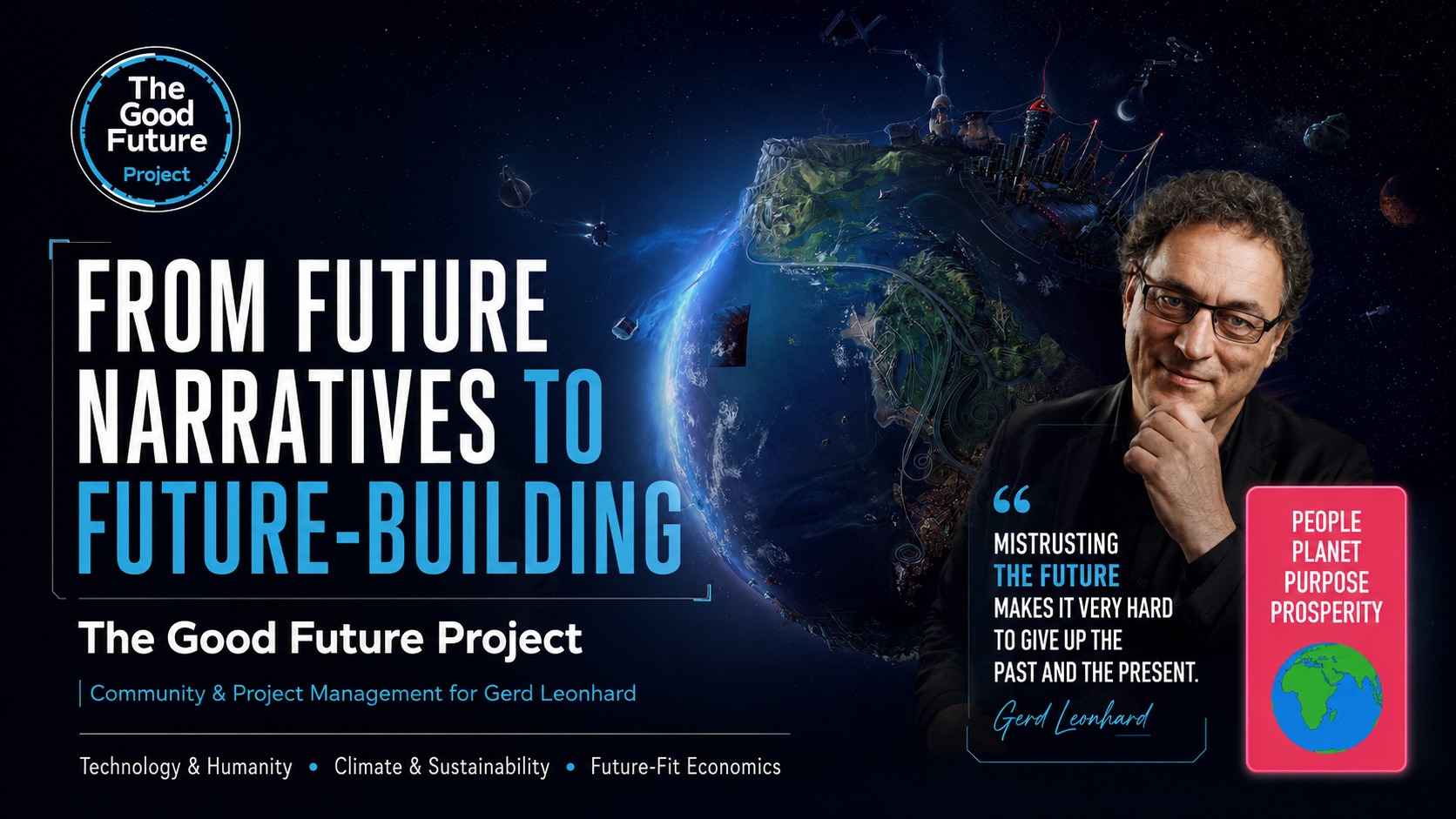
In 2022, I joined futurist Gerd Leonhard as Community and Project Manager for The Good Future Project, a global nonprofit initiative created to challenge the increasingly dystopian story surrounding the future. The project brought together futurists, writers, filmmakers, researchers, artists and changemakers exploring some of the defining questions of our time. How can technology remain in service to humanity? What would a genuinely sustainable economy require? How do we move beyond fear, fatalism and technological inevitability?
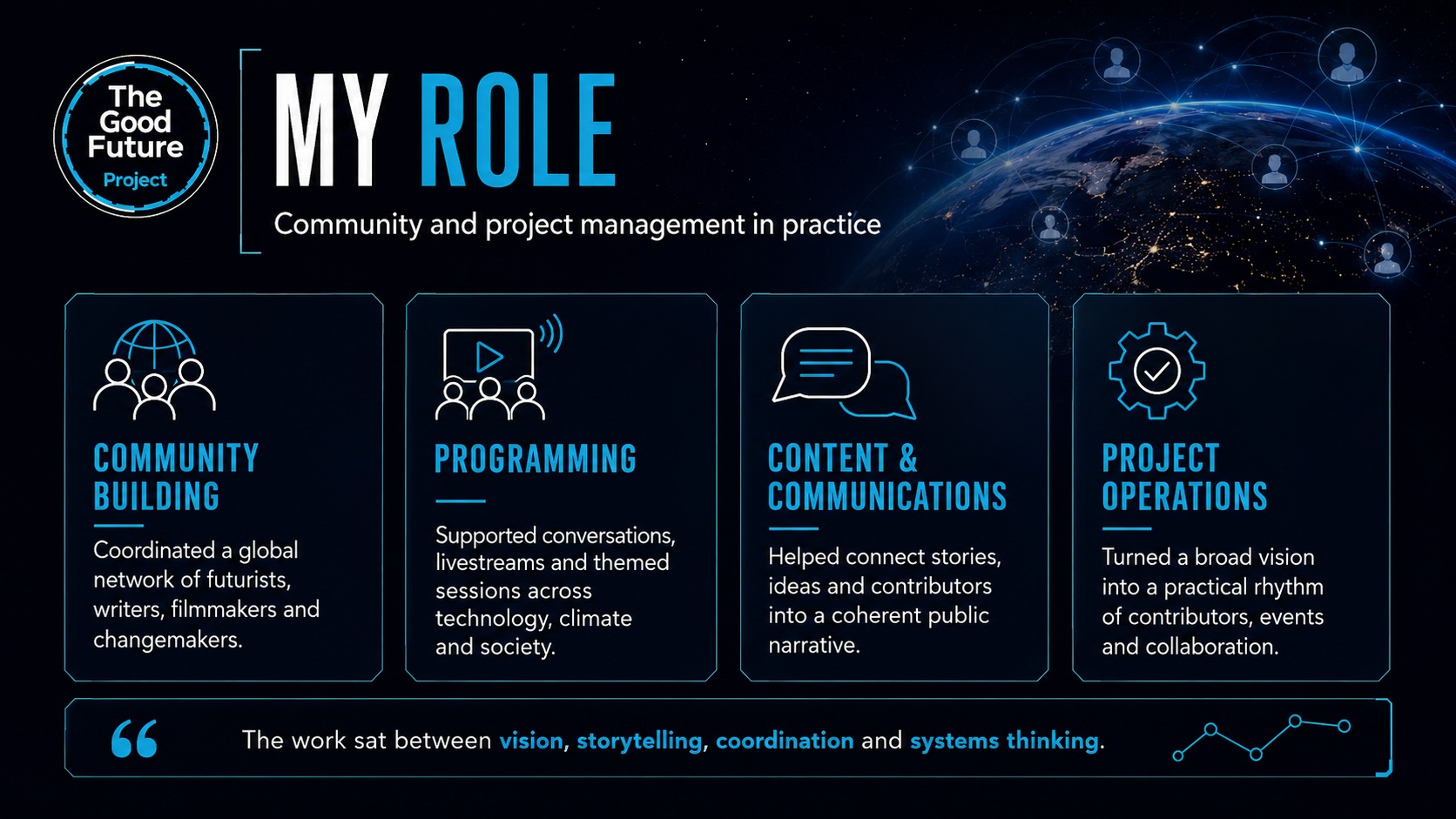
My role was to help turn that ambition into an active community, a public platform and a body of work.
The narrative problem
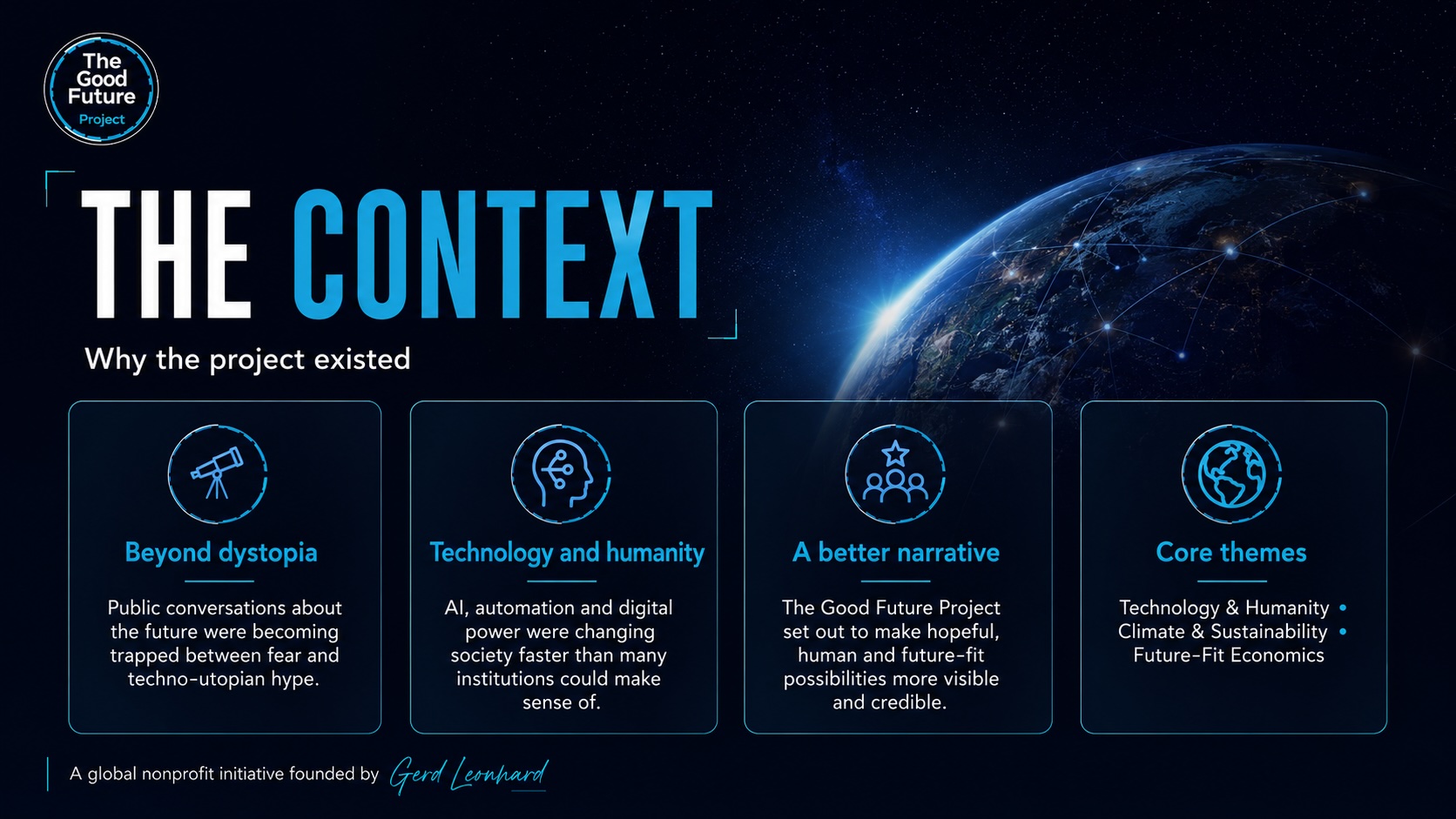
Public conversation about the future had become increasingly polarised. On one side, technological utopianism, the belief that innovation alone would solve the world’s problems. On the other, a growing dystopia, shaped by climate anxiety, inequality, automation and distrust in institutions.
Both narratives left people feeling powerless. One suggested technology would take care of everything. The other suggested collapse was inevitable. Either way, the conclusion was the same, meaningful choice had already disappeared.
The Good Future Project began from a different proposition, a good future is still possible, but it depends on the decisions, values and actions people choose today. This was not about denying risk. It was about restoring imagination, agency and responsibility, creating a credible alternative to both blind optimism and paralysing pessimism.
What we built
A compelling idea does not automatically become a living community. The project needed contributors from different countries, disciplines and worldviews while maintaining a coherent purpose. It needed regular rhythms of participation, not just a manifesto.
We coordinated a growing international network of thinkers and creators working across futures, climate, technology, economics, ethics and culture. The community was multidisciplinary by design, a filmmaker, an economist, a technologist and a climate activist all approach the future differently, and the value came from letting those perspectives meet rather than flattening them into one voice.
The space was created for a mix of conversations, livestreams, contributor sessions and themed gatherings where members could exchange ideas and bring different perspectives into public discussion. One strand focused specifically on creating space for women working in futures and technology, whose perspectives were often less visible in mainstream future narratives.
The work was not only about building an internal community, it was about contributing to a wider cultural shift, making more human and hopeful futures visible enough to be discussed, questioned and pursued.
Three themes that still shape my work
The project explored technology and humanity, not only what technology can do, but what it should do, and what must remain meaningfully human regardless of what becomes technically possible.
It explored climate and sustainability, treated not as a separate environmental issue but as a defining condition shaping every future decision, and the transition required from extractive systems toward regenerative ones, and it explored future-fit economics, questioning whether a model centred narrowly on profit, growth and GDP could meet the needs of the future, and exploring alternatives grounded in people, planet, purpose and shared prosperity. This strand became especially important to my later work on values-led venture design and Bloomforge Lab.
What I learned
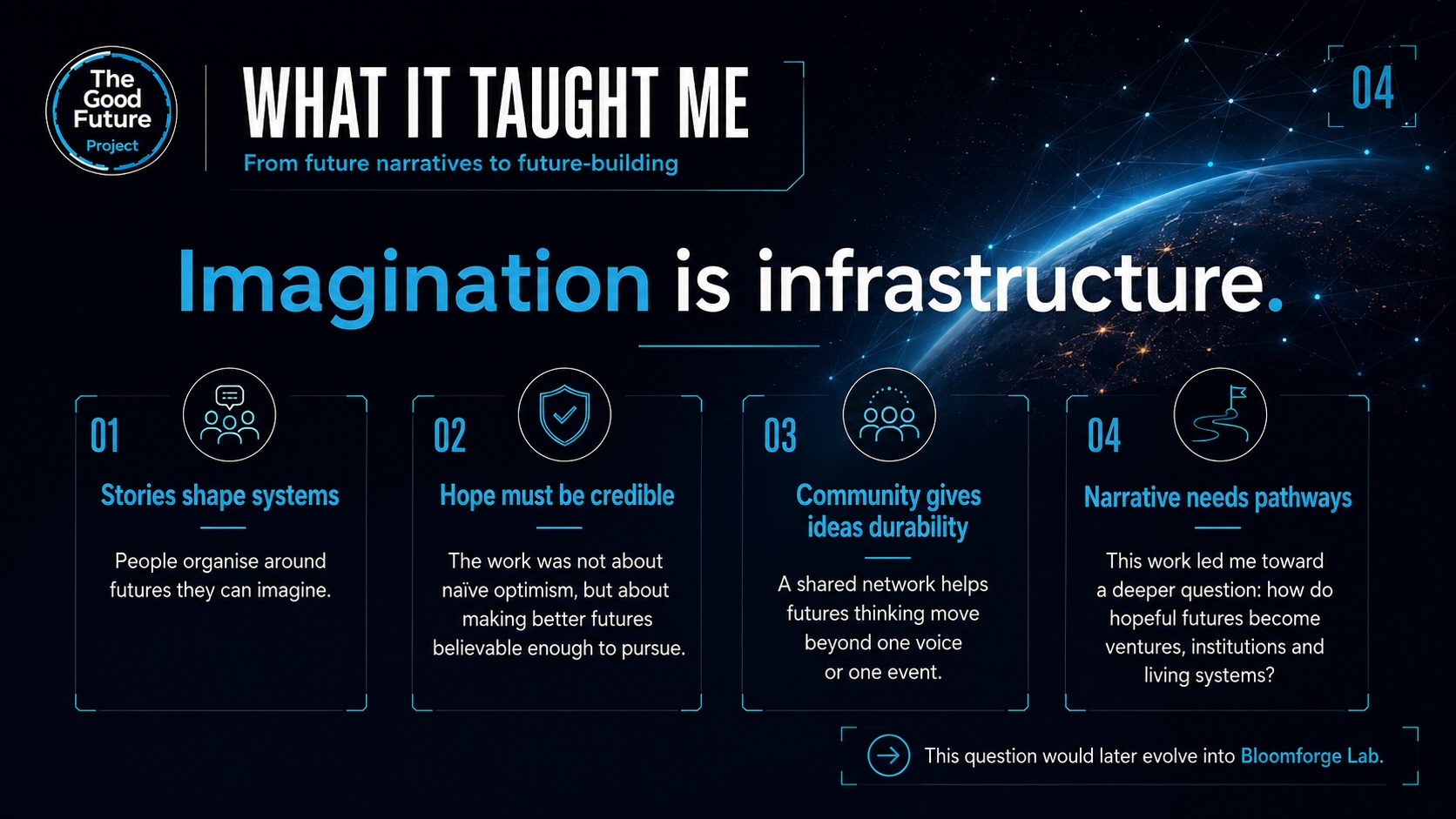
Imagination is infrastructure. People cannot organise toward a future they are unable to imagine. When the dominant story is one of inevitability or collapse, people behave as though meaningful choice has already disappeared. A different story reopens the field of possibility.
Hope must be credible and it is not the same as optimism. Optimism assumes things will improve. Hope recognises difficulty while preserving the possibility of action. The most powerful futures narratives do not ignore crisis or inequality, they show that another direction remains possible and name what it would demand.
Community gives ideas durability. An idea can be compelling and still disappear. A community allows it to be questioned, expanded, shared and carried by more than one person. The social infrastructure around an idea is often as important as the idea itself.
Diverse voices do not appear automatically. A platform can describe itself as global and open and still reproduce familiar patterns of visibility and authority. Participation has to be actively designed, through invitations, relationships and genuine opportunities to influence the direction of the work.
Narrative without pathways can remain abstract. The project showed me the power of culture and storytelling. It also clarified the next question in my own practice. Once people can imagine a better future, how do we help them build it? How do hopeful narratives become ventures, institutions, policies and economic systems? This question would later become central to Bloomforge Lab.
How this changed my practice
Before this project, much of my work focused on designing services, programmes and organisational systems. The Good Future Project taught me the cultural layer underneath all of that.
A system is held in place not only by policies, technologies and incentives. It is also held in place by stories, about what progress means, what technology is for, what success looks like, whether people have agency and who is entitled to shape what comes next.
Changing a system therefore requires more than a better solution. It often requires a new narrative through which people can recognise and organise around a different possibility. This became a foundational part of my approach to participatory futures. The future is not authored only through strategic plans. It is also authored through the images, language and stories that define what people believe can exist.
From a good future to living systems
The Good Future Project taught me how to make alternative futures visible. Bloomforge Lab carries that learning forward by asking how those futures might become tangible.
The Good Future Project asked, what might a good future look like? Bloomforge asks, what should we build now to help that future take root? One helped change the narrative. The other is concerned with turning possibility into infrastructure.
Technology alone does not determine the future, neither do experts, institutions or markets. The future is shaped by the stories people inherit, the voices they hear and the communities through which they act. Future-building begins before the prototype. It begins with imagination, but imagination is only the beginning. The larger task is helping people move from seeing a different future to becoming capable of creating it.
Copyright @ Zahara Chetty PTY LTD 2026