Case Study: UX workflow intelligence to make user-centred design smarter


Before AI, there was workflow intelligence
In the beginning of the 2010s, when UX was a new thing for us, designers were producing valuable work around research, personas, journey maps, user stories, but those outputs were disconnected from each other and difficult to carry forward. As projects moved between phases, between teams, between handoffs, the user focus slowly disappeared. The user focus could disappear along the way.
The research that had informed the design decisions was no longer visible in the decisions themselves. As you went along, someone new to the project had no way of understanding not just what was being built, but why it mattered and who it was actually for. The knowledge artefacts were being created, it just wasn’t surviving.
What I began to notice
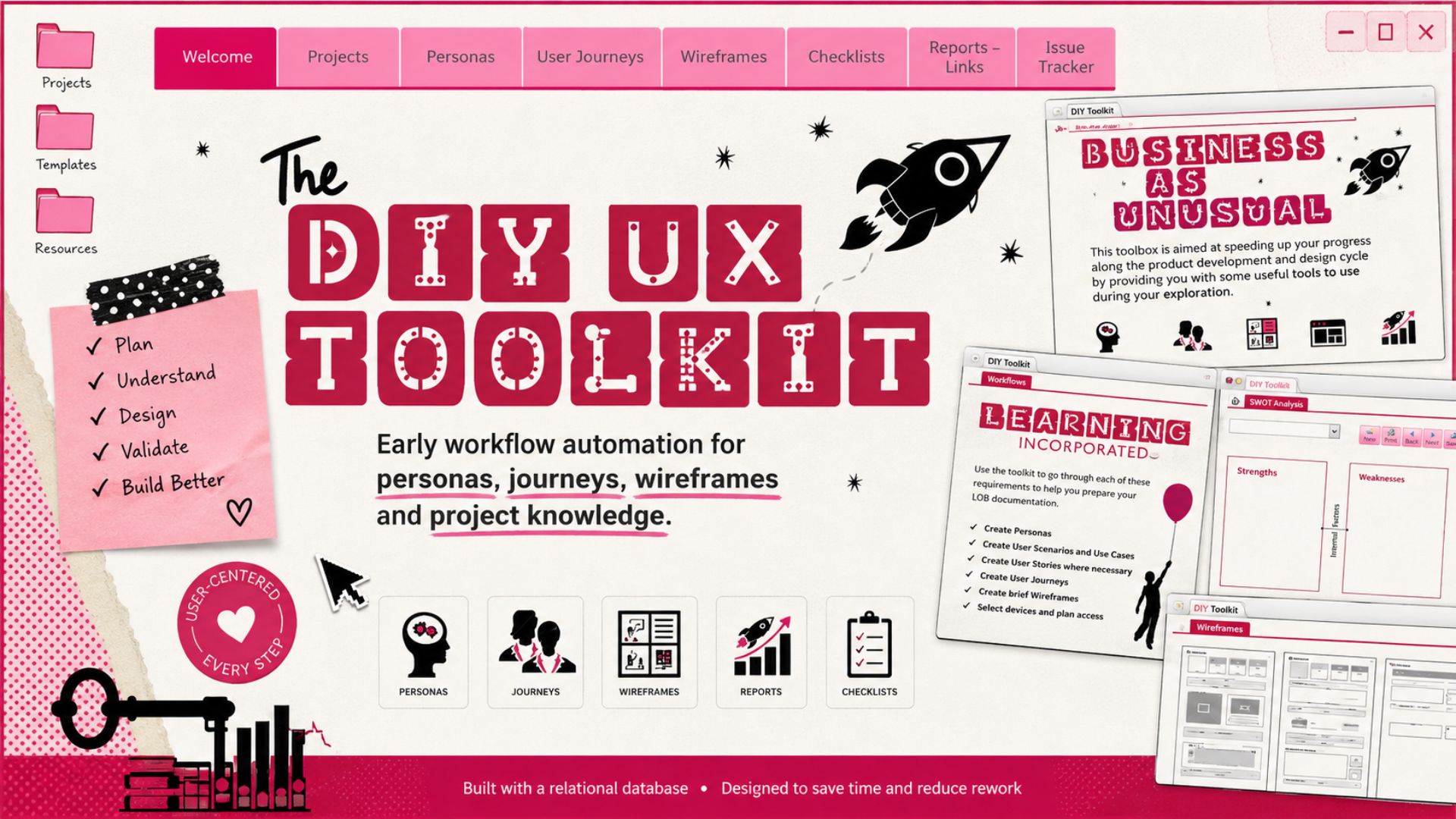
Using the tools available at the time, I designed a relational database and digital UX toolkit that connected these artefacts into a single working system. It looked kind of cool, for something built in the 2010’s. Mind the colours, it was a branding thing.
The idea was to treat personas, journeys and user stories not as static documents that lived in separate folders, but as linked objects in a shared information architecture. A team could trace any feature or user story back to the person, the need or the research insight that had generated it. Context moved with the work rather than being left behind at the end of each phase.
The system included guided creation of personas, journeys and user stories, with relationships built between research findings, design decisions and delivery artefacts. Teams could quickly edit and reuse existing work rather than starting from scratch each time. Shared comments enabled collaboration across the team. Printable workshop tools made the system useful in facilitated sessions. Outputs could be exported into JIRA or Excel. Embedded checks prompted teams to test their work against user-centred design principles, and a project-level score gave teams a simple signal of how well they were practising what they claimed to value.
The user experience was intentionally simple. The database behind it was intentionally complex. That inversion hide the complexity, surface the clarity was itself a design principle that I still use today.
What it was actually trying to do
The goal was not only efficiency. It was access.
User-centred design was being practised inconsistently, it was new, people were still learning how to do it, and the overhead of doing it rigorously was too high without specialist support. The toolkit was designed to lower that threshold, to make good practice easier for everyone to participate in, not just the people who already knew how.
This meant the system had to do more than store information, it had to carry intent. It needed to guide people through a process, not just receive their outputs at the end of it. It also needed to reduce the burden placed on individual experts by embedding enough of their knowledge into the system that others could follow it without them in the room.
What I understand now that I didn't have language for then
Looking back, this was an early form of workflow intelligence. It decomposed a design process into connected information objects, relationships, rules and reusable outputs. It asked how a system could carry context forward so that people didn’t need to recreate knowledge at every stage. It distinguished between the work that required human judgement and the work that could be structured, templated and systematised and it tried to take the second category off people’s plates so they had more energy for the first.
Long before agentic workflows, knowledge graphs or AI copilots became common language, I was already working on how technology could preserve organisational knowledge, automate repetitive production work, connect fragmented project information, guide people through a process, make good practice more accessible and reduce the burden placed on individual experts.
The vocabulary didn’t exist yet. The problem did and the design instinct behind the solution, that systems should carry complexity so that people can focus on meaning, is the same one that has run through every piece of automation work I have done since.
The thread it started
This project sits in a line that runs from automating school administration in a South African classroom, through relational design systems and conversational AI companions, to the agentic AI platform I built inside one of Europe’s largest telcos twenty years later.
The contexts changed completely but the tools changed beyond recognition. The underlying design question stayed the same, “How can the system carry more of the heavy lifting, preserving knowledge, reducing repetition, connecting fragmented information, while making the work clearer, easier and more human for the people doing it?”
Automation is most useful when it does not simply make work faster. It should preserve meaning, improve decisions and help more people participate well. That is what I was trying to build in that early relational database. It is what I am still trying to build now.
Copyright @ Zahara Chetty PTY LTD 2026