Case Study: From co-creation among institutions to participatory futures

Who gets to design the future?
For several years, I designed and facilitated human-centred innovation processes across international development, sustainability and social impact. The subjects varied widely, from youth employment, green jobs, biodiversity, the future of work, inclusive growth, digital transformation, community resilience. I worked with companies, NGOs, foundations, governments and global development partners across different countries and cultures.
The briefs were never simple. They concerned complex systems in which no single organisation held the full problem, the full knowledge or the power to create change alone. My role was to help people understand those systems, bring different stakeholders into conversation and translate collective insight into programmes, services and practical interventions.
At the time I called this human-centred design. It taught me how to listen, facilitate collaboration, make complexity visible and help diverse groups move from discussion toward action. It also taught me where the practice needed to evolve.
What I began to notice
Many of the engagements followed a familiar design-thinking process. Research the challenge, map the ecosystem, bring cross-sector partners together, align around shared needs, generate ideas and co-design (not always) concepts and implementation pathways.
This was a significant improvement on institutions designing alone because t created shared understanding across organisational boundaries and helped people recognise that complex challenges required collective action.
However, over time I began to notice a pattern.
In most institutional design processes, the people with formal authority, funding and technical expertise were well represented. The people most affected by the system were sometimes interviewed, researched or invited into selected activities, but they did not always have equal influence over how the problem was framed, which assumptions were questioned, which futures were explored, what success meant or which trade-offs were considered acceptable.
A room could be diverse and collaborative while still carrying the power structures of the wider system. People could be asked to contribute ideas without being able to challenge the future the institution had already chosen. Communities could be consulted about implementation while remaining absent from the earlier strategic decisions. A persona or research report could represent lived experience. It could not replace the presence, agency and interpretation of the people themselves. That gap became increasingly difficult to ignore.
Can we call a future participatory when the people who must live inside it are not helping to author it?
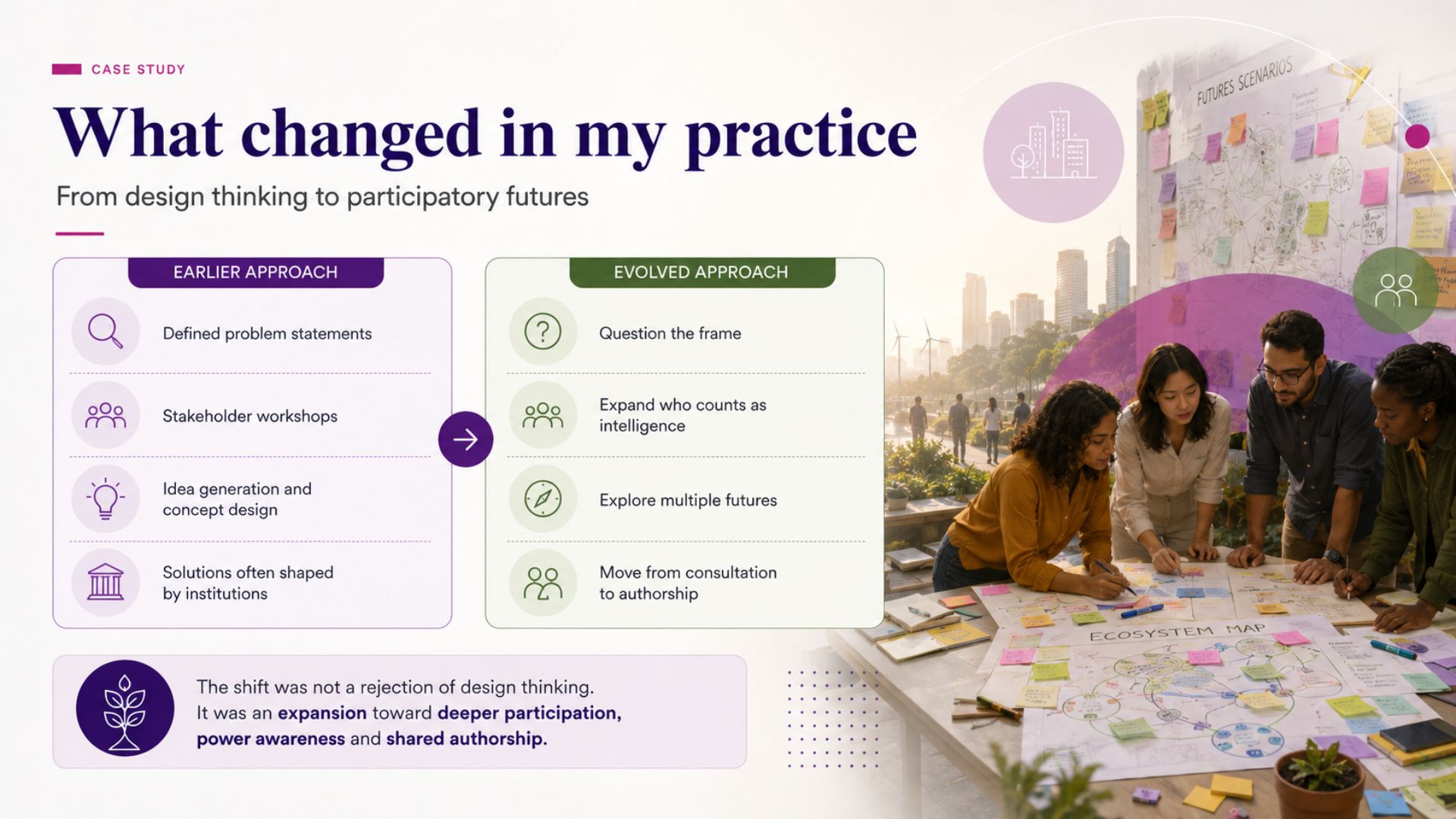
From design thinking to participatory futures
Design thinking taught me to begin with people but participatory futures taught me to begin with power, possibility and authorship.
The shift was not a rejection of the practices I had developed, it was an expansion of them. I still value research, systems mapping, prototyping and collaborative design, but I now place them inside a wider process that asks different questions before any design work begins.
Who defined the original challenge? Which future is already being treated as inevitable? Whose worldview is embedded in the brief? What forms of knowledge are missing from the room? Who benefits from the preferred direction and who absorbs the costs?
Participatory futures moves the work upstream. It brings people into the process before the strategic direction, the operating model or the technology has already been decided. It treats lived experience not as data to be collected but as intelligence that changes what the question even is.
In the youth employment work I did, for example, the question shifted from how do we prepare young people for available jobs to what forms of work, livelihood, ownership and participation should the next economy make possible, and who gets to decide? That reframe changes everything that follows.
When this work is useful
Participatory futures is especially valuable when:
- Existing assumptions are no longer reliable
- A decision will affect many different groups
- Stakeholders hold competing views of the problem
- Technology is moving faster than organisational understanding
- Communities are being asked to accept a future they did not help shape
- A strategy needs imagination as well as analysis
Depending on the question, an engagement can produce:
- Alternative future scenarios
- Shared principles and decision criteria
- Opportunity territories
- Strategic provocations
- Venture, service or policy concepts
- Ecosystem maps
- Experiential futures
- Action portfolios and transition pathways
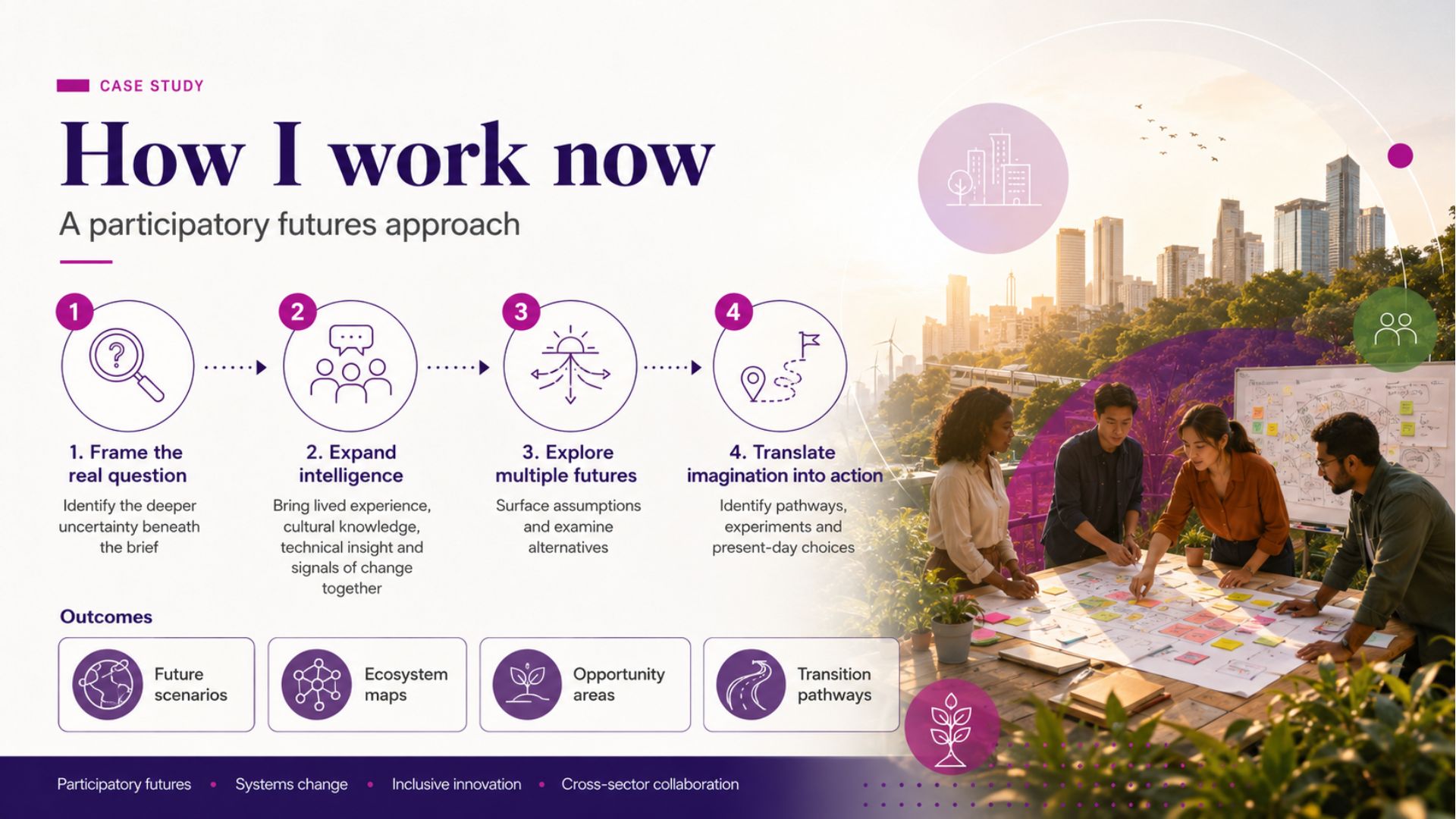
How I work now
1. Frame the real question
We identify the deeper uncertainty beneath the stated brief.
2. Expand who and what counts as intelligence
We bring together lived experience, technical knowledge, cultural perspectives, signals and systemic context.
3. Explore multiple futures
4. Translate imagination into decisions
Why this matters more in the age of AI
The questions I encountered in development and sustainability work have become more urgent as AI reshapes institutions.
Organisations are making rapid decisions about which work gets automated, which capabilities will matter, how services will be delivered, what machines will be trained on, who retains decision-making authority and which communities gain or lose access. These are not only technical decisions, they are decisions about human futures.
If employees, citizens and communities are invited in only after the technology, strategy and operating model have been selected, participation becomes an adoption exercise. People are asked how to live inside a future someone else designed.
Participatory futures creates a different possibility. It brings people into the process while assumptions are still open and meaningful choices can still be made. The aim is not to ask everyone to become a futurist or technical expert. It is to recognise that the people who will live with a system hold knowledge that the system cannot afford to ignore.
What this work taught me
The most important lesson from this chapter of my practice was not that experts or institutions should disappear. Their knowledge, resources and ability to act remain essential. The lesson was that no single group can see the whole system, and that futures become more grounded, more legitimate and more capable of enduring when diverse forms of intelligence can meet without one automatically dominating the others.
My practice evolved from helping organisations design better solutions for people toward helping diverse groups shape futures with one another.
The central question is no longer only how might we solve this problem? It is also, “Who gets to imagine what comes next and how do we create the conditions for them to become genuine authors of it?
That question now sits at the centre of everything I do.
Copyright @ Zahara Chetty PTY LTD 2026