Case Study: Automating to make room for what really matters

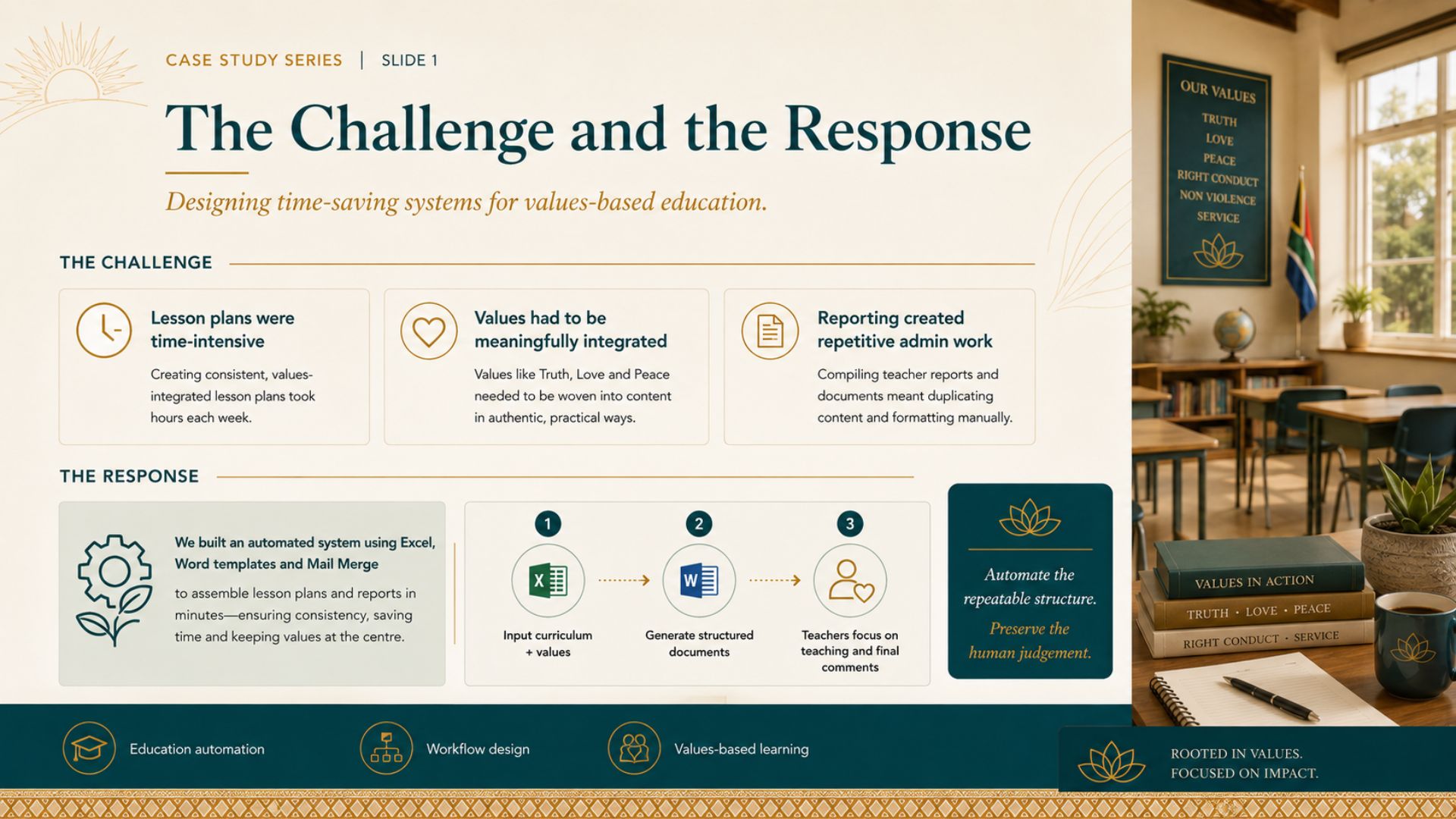

Automating values-based lesson planning and school reporting in the early 2000s.
My earliest automation work began in a classroom in South Africa. I was teaching at a values-based school, where education was grounded in both the national curriculum and an explicit commitment to human values. Every lesson had several layers to it. It needed to meet formal curriculum requirements, it had to open with a meditation or reflective activity. Values education had to be meaningfully woven into the subject matter and not just added as a statement at the end, but genuinely integrated into how the content was taught, and it needed clear learning objectives, activities, resources and assessment criteria.
The intention behind each lesson mattered enormously. The process of producing it was consuming time that should have been spent on teaching. Teachers were repeatedly assembling similar information across subjects, grades and reporting periods. Much of the work was searching, copying, formatting and checking, ensuring the right values, the right curriculum references and the right lesson components were all present and correctly structured. Important work. Also largely mechanical.
I began asking a question that would follow me for the next two decades, “What can the system carry, so that people have more time for the work only they can do?”
The lesson planning system
Using the tools available at the time, I built an automated lesson-planning system using some very simple things like a database or spreadsheet and mail merge.
Teachers could select the relevant subject, curriculum area, lesson elements and values focus. The system would then assemble the required components into a structured lesson plan, including the opening meditation, the values integration and the curriculum requirements, without the teacher having to reconstruct that architecture from scratch each time.
The aim was not to automate teaching, it was to remove the repetitive administrative work surrounding it. The system provided structure and consistency while leaving teachers fully responsible for the parts that required professional judgement, creativity and genuine knowledge of their learners. The care stayed human. The scaffolding became systematic.
School reporting
The same problem appeared in student reporting.
Teachers were spending significant time entering recurring information, formatting documents and producing standardised sections that changed very little from learner to learner. I helped automate the reporting structure in many different schools, so that the repeatable elements could be generated systematically. Teachers then reviewed the output, made their professional assessment and added the personalised comments that only they could write, the observations that came from actually knowing the child.
The principle was the same in both cases. Automate the repeatable structure, preserve the human judgement and return attention to the work that matters most. The problems were also the same, the chaos of unconstrained data.
What this taught me
At the time I did not describe any of this as workflow transformation or human-centred automation. I was simply trying to make an overly demanding process more workable for people who were already giving a great deal of themselves to their work.
But looking back, the principles were already there and they have remained remarkably consistent across everything that followed.
Begin with the lived frustration, not the technology. Understand the whole workflow before touching any part of it. Separate repetitive work from judgement-based work, and be precise about that boundary. Structure information so it can be reused rather than recreated. Let the system handle consistency and complexity. Keep people responsible for meaning, care and final decisions and always ask what you are giving back, not just what you are taking away.
The technology in that classroom was relatively simple. The design question was not. The challenge was to preserve the values and purpose of the process while reducing the administrative burden required to deliver it. That tension between efficiency and meaning, between automation and humanity is one I have been working on ever since.
The beginning of a longer practice
This was the starting point for a thread that has run through my entire career.
From automating school administration, I moved into relational systems for design teams, digital products, conversational assistants, AI strategy and agentic platforms. The contexts changed, the tools changed enormously but the underlying questions and purposes did not.
“What can the system carry, so that people have more time for the work only they can do? How do we redesign work so that technology carries the repetition, while humans retain the care, the judgement and the responsibility?”
That early classroom experiment taught me something I still believe today and still design from. Good automation does not remove the human from the system. It creates more space for people to be fully human within it.
Copyright @ Zahara Chetty PTY LTD 2026